Tadanori Sakamoto (Chief Curator, Takenaka Carpentry Tools Museum)
1. Focusing on the Evolution of Function and Form
When humans first twisted plant fibers into ropes, they were likely applied to building work at a very early stage. A variety of techniques developed around ropes: laying out plans by marking boundaries, measuring verticality by suspending a weight, and checking horizontality by aligning with the surface of water held in a container. Craftsmen naturally became familiar with ropes, and it is reasonable to assume that they soon recognized the potential of snapping a colored line to transfer straight lines onto materials—a technique known as ink-lining. Indeed, traces of ink lines remain at ancient Egyptian sites, and references to ink-lining can also be found in texts from ancient Greece and China.
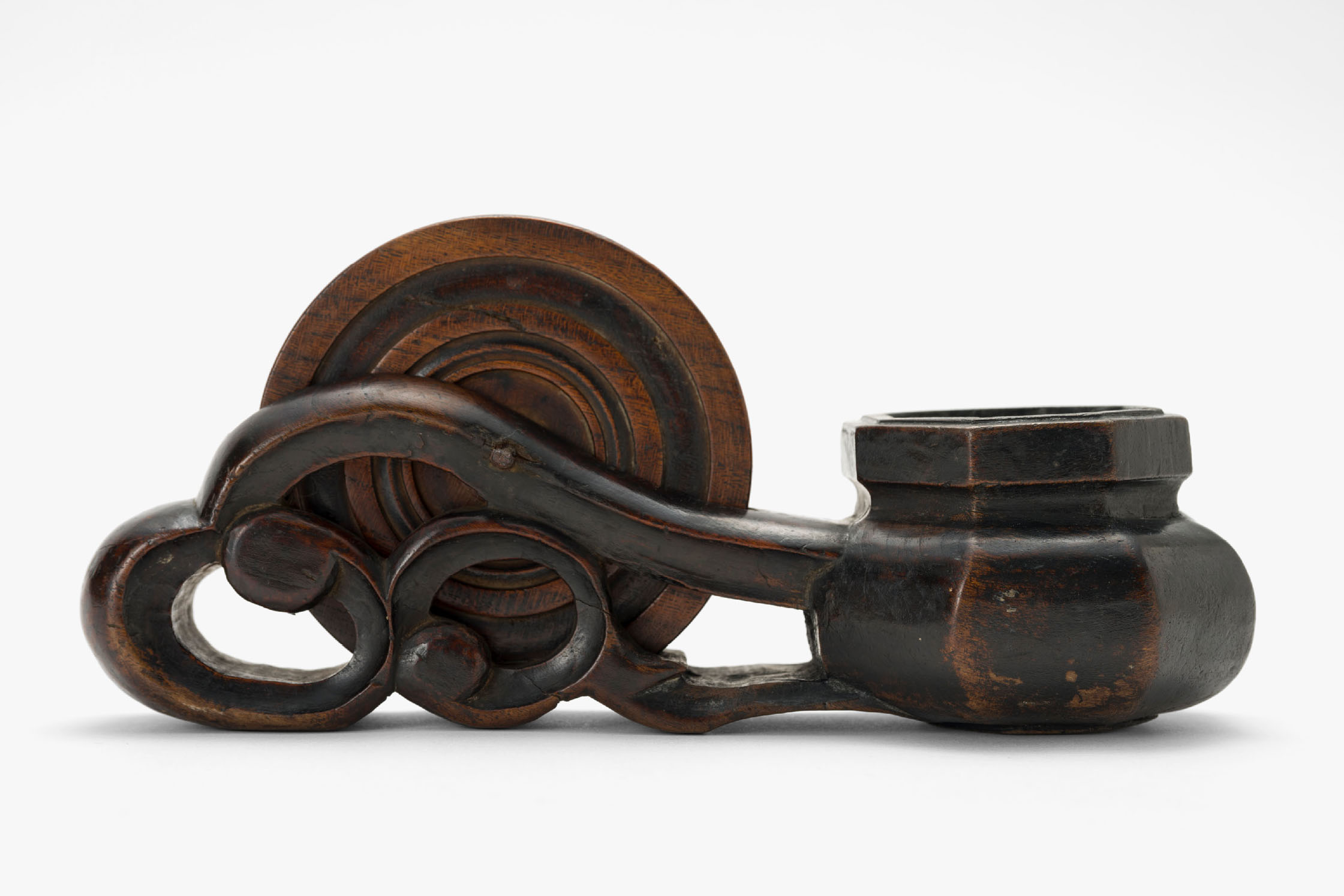
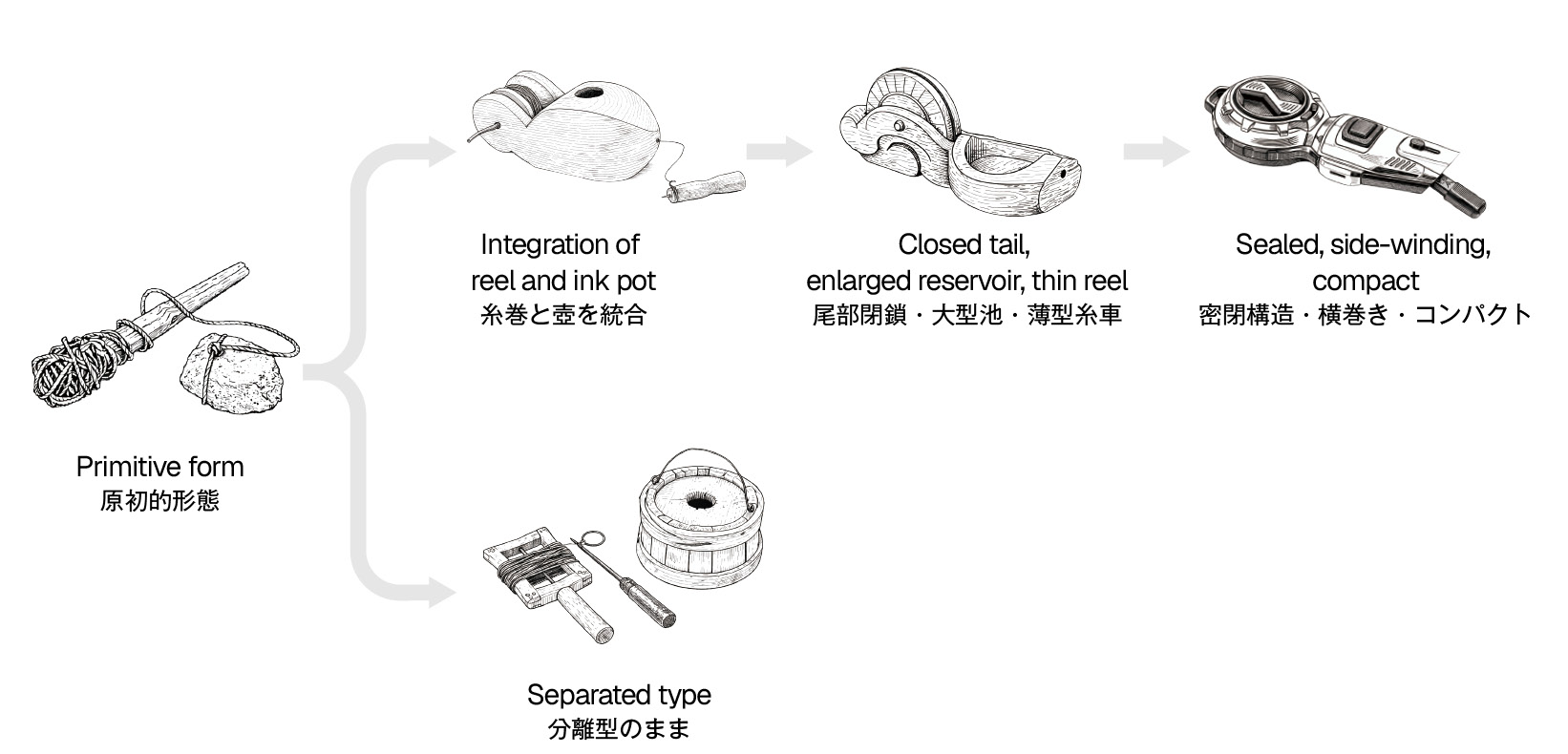
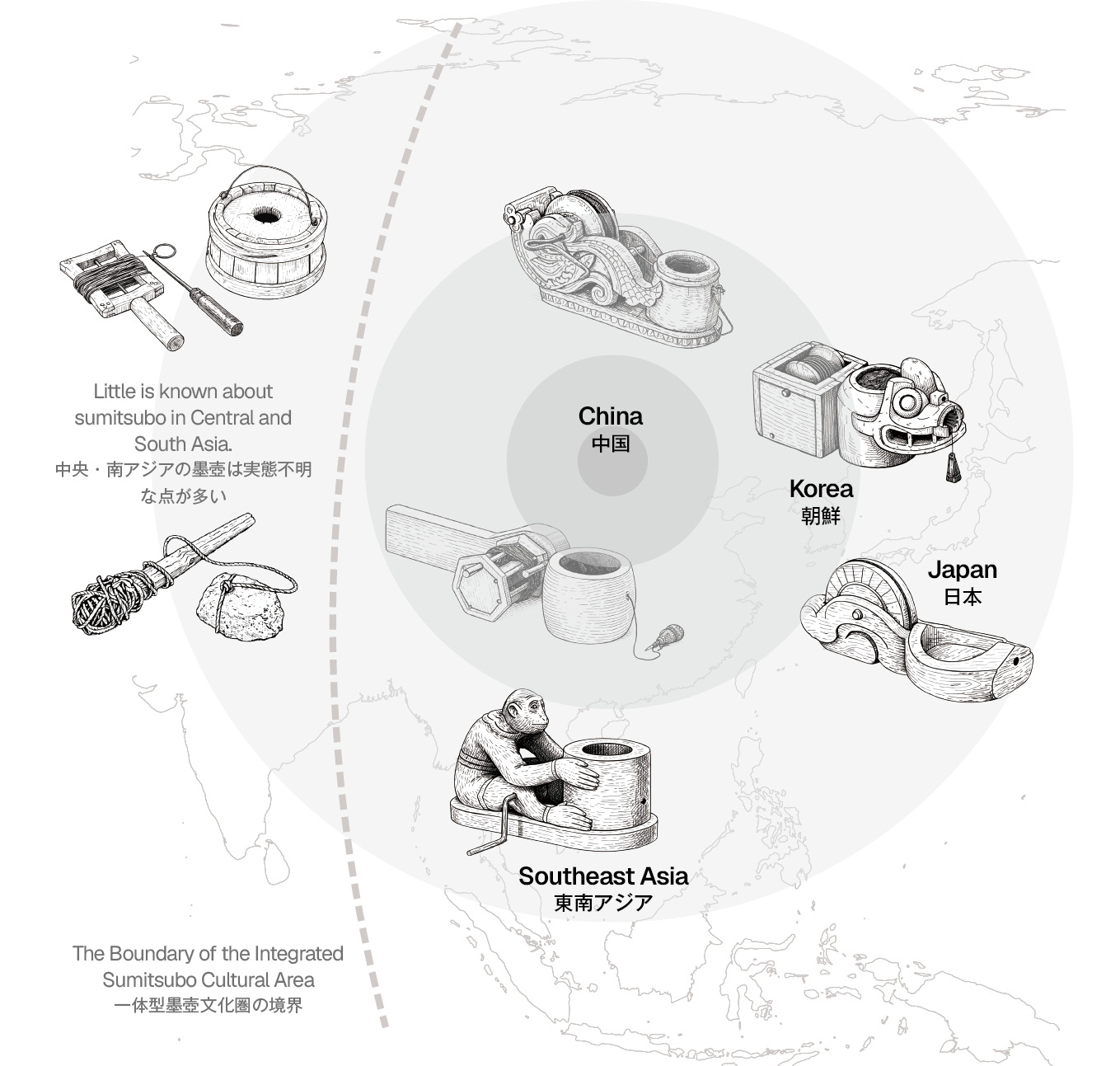
In early periods, the “line reel” and the “container for coloring” are thought to have existed as separate tools. To wind up a line, it sufficed to wrap it around a stick, and for coloring, a pot or bucket was adequate. Even today, in some regions, such separated tools continue to be used. At some point, however, in East Asia, a tool that combined the line reel and the coloring container—the ink line reel (Sumitsubo)—was invented. In Chinese tradition, this invention is attributed to the legendary ancient master craftsman Lu Ban. Although the actual inventor remains unknown, from the standpoint of civilizational development it is reasonable to regard China as its place of origin. From there, the tool likely spread eastward through the Korean Peninsula to Japan, and southward to the countries of Southeast Asia.
In Japan, the term suminana (inked rope) appears in early sources such as the Nihon Shoki and the Man’yōshū, suggesting that the earliest form consisted solely of a rope, without an integrated container. However, artifacts excavated from Nara-period sites already attest to the existence of integrated Sumitsubo. Early examples were simple concave forms hollowed out of squared timber, but over time they evolved into horizontally elongated shapes that fit more comfortably in the hand. To prevent damage, the tail end was eventually closed, and the reel itself developed into a larger, thinner form that was easier to turn.
During this process, some examples appear to have been fitted with a metal ring at the center to allow vertical measurement, but as usability was further refined, this function became independent and developed into the plumb bob. Other variations also emerged: compact rectangular forms (the so-called ichimonji type), designed for easy storage in a toolbox, and ladle-shaped types with enlarged ink reservoirs to prevent the ink from drying too quickly during outdoor work. In this way, the form and function of the Sumitsubo have always been closely intertwined, and by comparing examples across regions and periods, these relationships can be clearly discerned.
2. Enjoying Diversity Across Regions and Periods
In general, carpenters rarely decorate their own tools. The Sumitsubo, however, stands as a notable exception, having attracted exceptional attention to form and ornamentation. This tendency is not limited to Japan but is widely observed in China, Korea, and Southeast Asia as well.
One reason for this lies in the fact that the Sumitsubo is primarily made of wood. Unlike tools such as saws or chisels, which consist largely of metal components, the Sumitsubo could be readily made by craftsmen themselves, offering ample scope for expressing skill and aesthetic intent. That said, considering that other tools made mainly of wood—such as marking gauges, planes, and awls—do not necessarily feature elaborate decoration, material alone cannot fully explain this phenomenon.
More significant is the fact that the Sumitsubo has long been regarded as a “sacred tool.” In Japan, during carpentry rituals associated with building construction, the Sumitsubo is placed on the altar alongside the carpenter’s square and the adze (p. 8). Just as the adze symbolizes the act of transforming a log into timber, the square and the Sumitsubo are tools for sumikake—marking lines on wood. Through the drawing of ink lines, raw timber is endowed with new meaning and function as a building material.
Furthermore, in ancient Chinese thought, as seen in the concept of gui, ju, zhun, and sheng, the accurate straight line produced by the inked line was regarded as one of the fundamental principles underpinning the creation of the world, alongside the compass that draws circles, the square that defines right angles, and the level that establishes horizontality. Such ideas further explain why the Sumitsubo came to be treated as a special tool.
Because of this significance, Sumitsubo were expected to possess forms befitting their role. Examples abound: those shaped like auspicious mythical animals, those carved with intricate patterns, and those rich in narrative imagery drawn from legends and historical tales. When compared by country or region, distinct cultural backgrounds and aesthetic preferences become apparent, while even within a single region, differences among individual makers can be discerned. Appreciating the cultural contexts behind these forms, or simply smiling at the playful, humorous designs born of a carpenter’s imagination, is itself one of the pleasures of viewing Sumitsubo.
3. Appreciating the Skill of Form and Carving
Because carpenters are not professional sculptors, many Sumitsubo retain a certain rustic quality in their form—a characteristic that carries its own appeal. From the Meiji period onward, however, specialist woodcarvers increasingly took part in the production of Sumitsubo in Japan, resulting in a marked refinement of overall balance and intricacy of carving. Works by craftsmen regarded as masters possess a particular vitality, with carved animals that seem poised to spring into motion.
Tracing the production process by which these Sumitsubo took shape is also rewarding. From the selection of materials, through rough shaping and detailed carving, to the final finishing, understanding the techniques and labor involved in creating a single piece adds depth to the act of viewing.
Among these works, the giant Sumitsubo—enlarged beyond practical necessity and created expressly for display, with decoration taken to its extreme—represent the culmination of this tradition. Approaching them as one would a sculptural work, one may begin by observing (1) the overall form and proportions; then consider (2) the use of curves and straight lines, and the rise and connection of surfaces; next examine (3) the contrast and rhythm between deep and shallow carving; and then focus on (4) details such as eyes, mouths, fur, and ornamental patterns. Finally, one may reflect on (5) the subject of the carving and its meaning and background.
