By examining excavated artifacts and objects handed down over time, we can begin to glimpse what ancient sumitsubo may have looked like. The sumitsubo unearthed at the Sakane Site in Kawanishi City, Hyogo Prefecture is an extremely simple object, made by hollowing out a squared timber. A round ink reservoir is carved into the top, while the side boards rise in a warabite-like form. Its straightforward construction places clear priority on practical use.
Sumitsubo from the same period have also been found at the Heijo-kyo site and the Shida District Government Office site in Fujieda City, Shizuoka Prefecture. All are concave in form, equipped with round ink reservoirs, and share an unadorned, utilitarian appearance.
By contrast, the miniature sumitsubo preserved in the Shosoin presents a somewhat different character. Although very small, measuring only 4.2 cm in length, the boar's-eye motif of the ink reservoir and the curves of the warabite are carefully refined. Here we can sense a shift beyond mere utility, toward an emerging awareness of the sumitsubo's form itself: the first stirrings of stylistic expression.
2. Toward a Refined Form
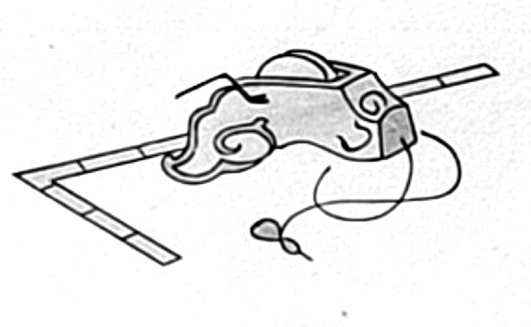
Entering the medieval period, the sumitsubo gradually evolved into a more refined form while still retaining traces of its ancient origins. One example is the sumitsubo discovered at the Great South Gate of Todai-ji, the Nandaimon, believed to date from the Kamakura to Muromachi periods. Its basic structure is a concave form, hollowed from a rectangular block of wood, and it preserves elements seen in earlier examples, such as a small ink reservoir and fern-like side plates.
At the same time, the overall proportions become more elongated, a hanging fitting is added at the center, and the reel is secured with metal fittings. Subtle refinements appear in the details as well: the ink reservoir takes on a faint quince-like shape, and the side plates curve in two stages.
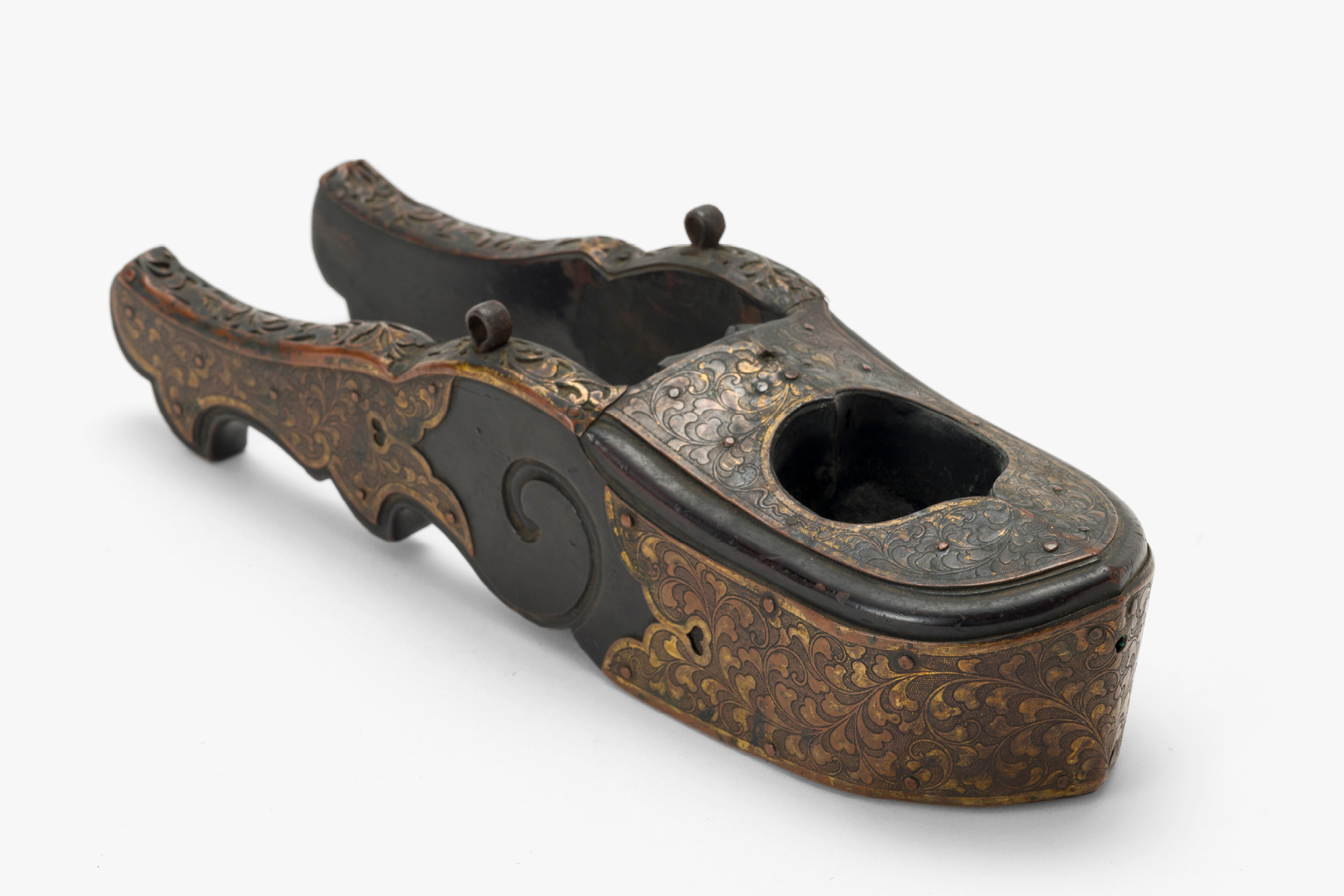
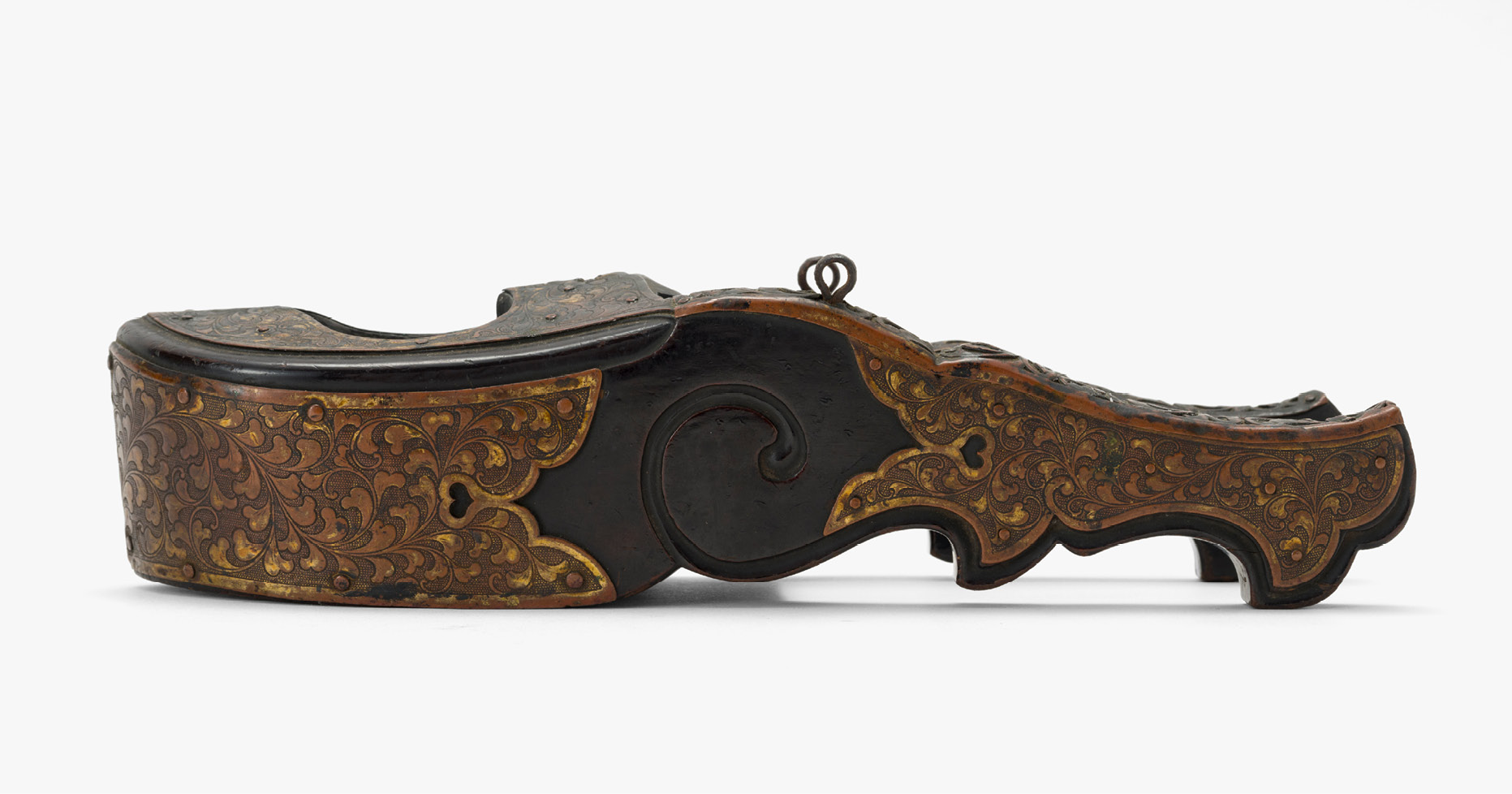
A sumitsubo bearing the date Oei 3 (1396) (Fig.1) shows a similar form, but is thought to have been made for ceremonial use, with metal fittings that are even more richly decorated. These features were later carried forward into ceremonial sumitsubo of the early modern period, including those associated with Nikko Toshogu, Kasuga Shrine, and Todai-ji.
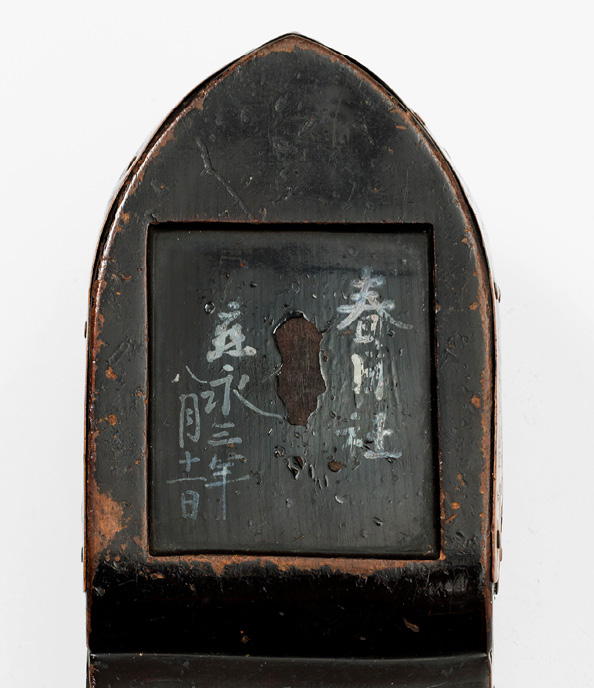
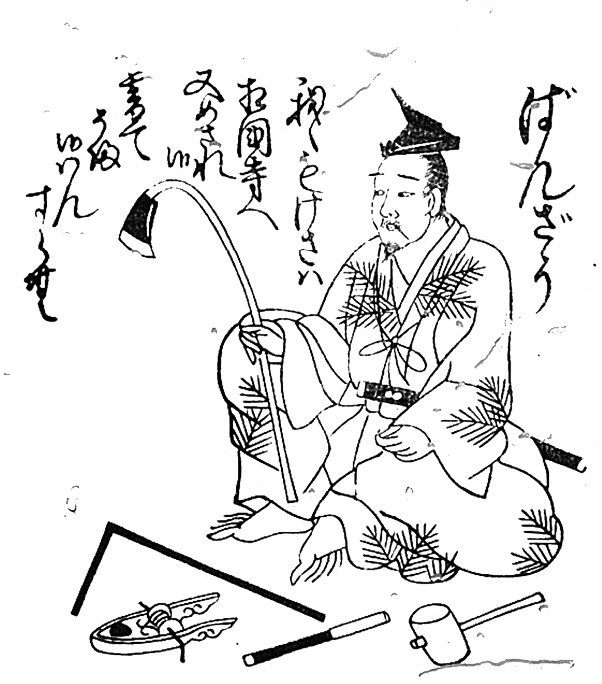
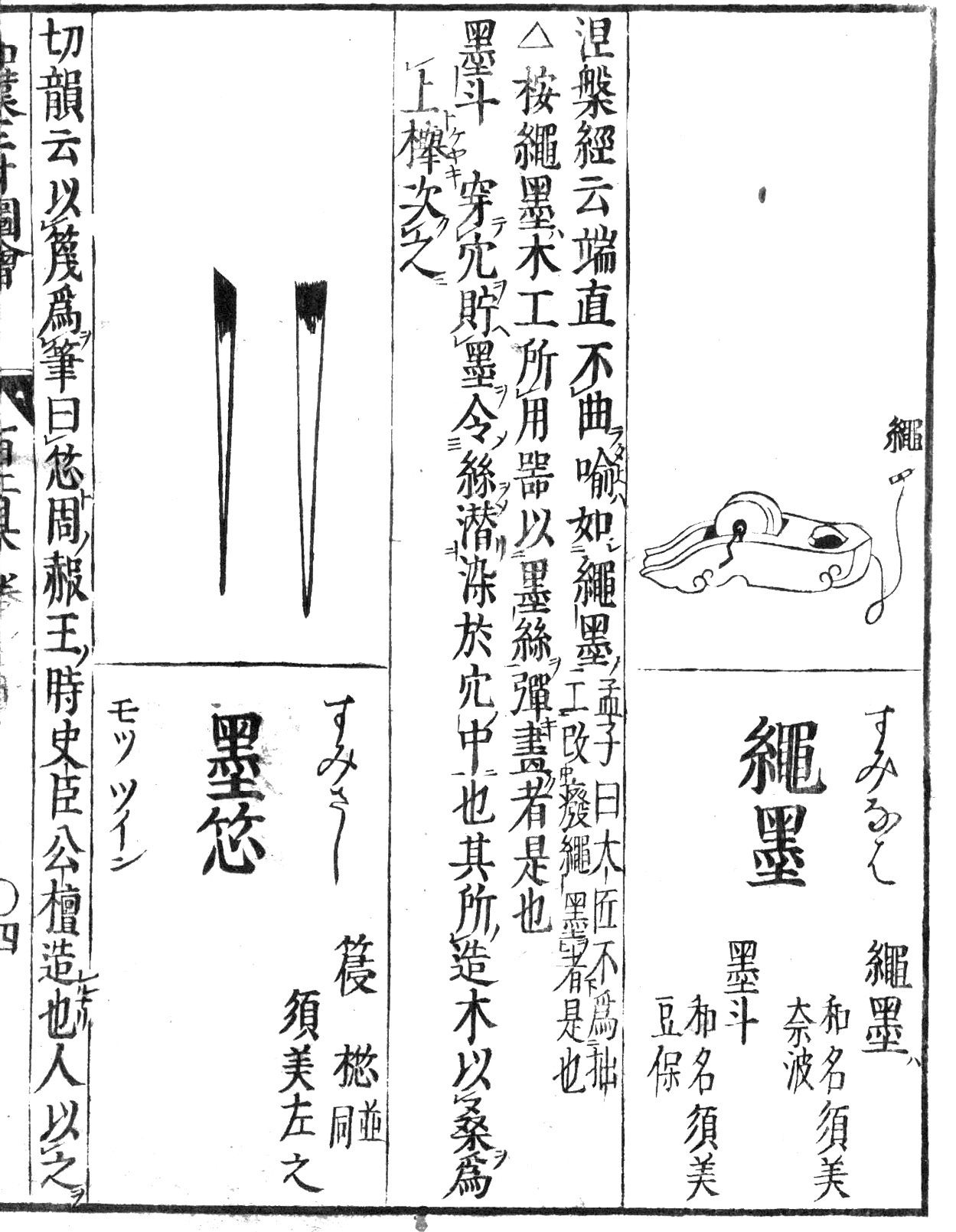
Fig.1Sumitsubo with inscription Oei 31396, wood / brass, Suda Collection, inv. A112724, 7.0 x 8.0 x 16.8 cmAn ink inscription on the underside of the reservoir reads, 'Kasuga Shrine, Oei 3, eighth month, eleventh day.' The reel and suspension ring are missing. Both the top and sides are covered with brass fittings engraved with arabesque designs, while a whirl motif appears in the wooden body at the center of the sides. The warabite form is composed of multiple intersecting curves.Fig.2Side view of Fig.1Fig.3Bottom view of Fig.1Fig.4Illustration from the Banjo section of Shichijuichi-ban Shokunin Uta-awase1812, inv. C140006Similar to the sumitsubo found at the Great South Gate of Todai-ji. The original picture book dates to around 1500, in the Muromachi period.
3. Reaching Maturity
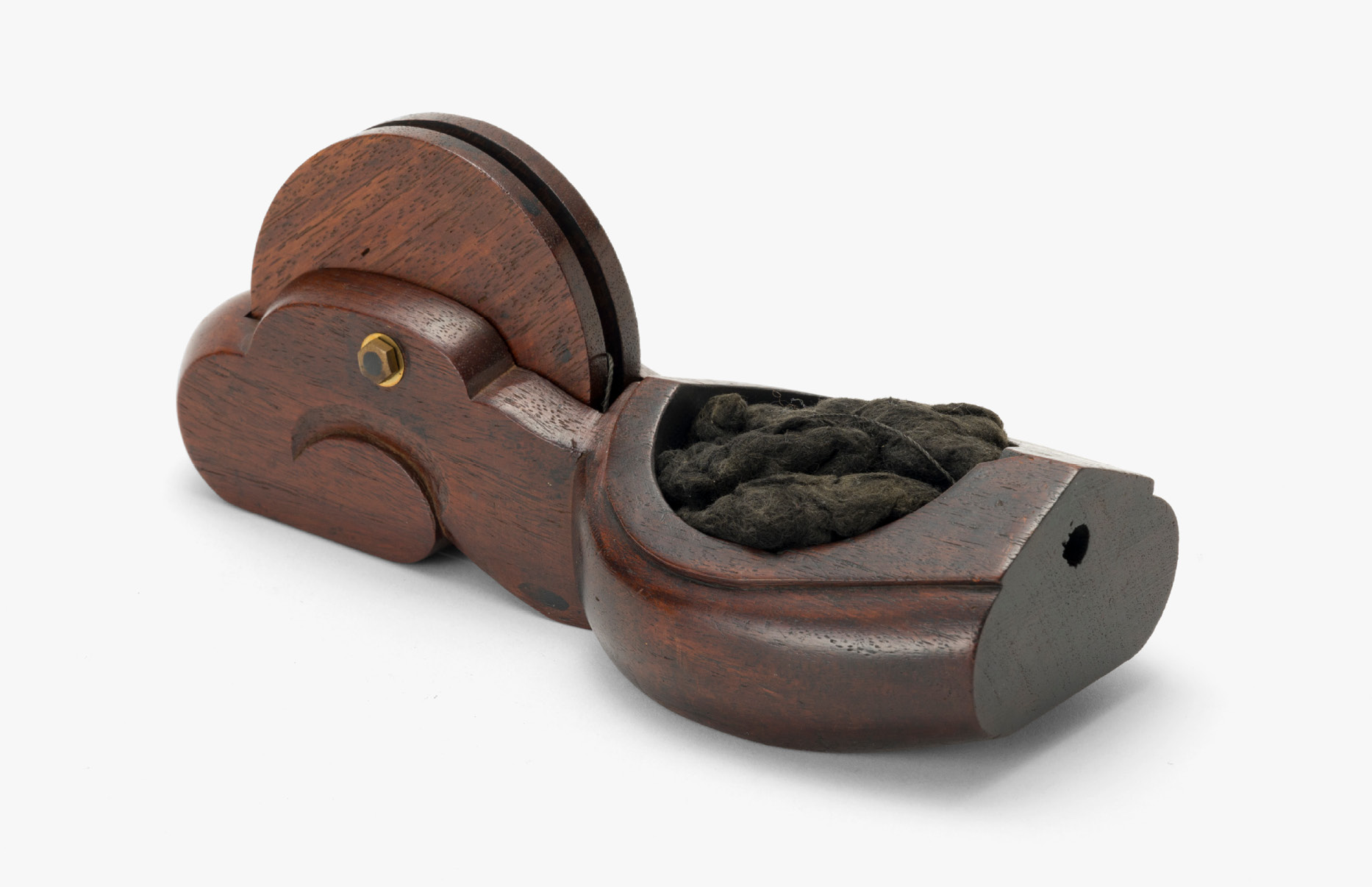
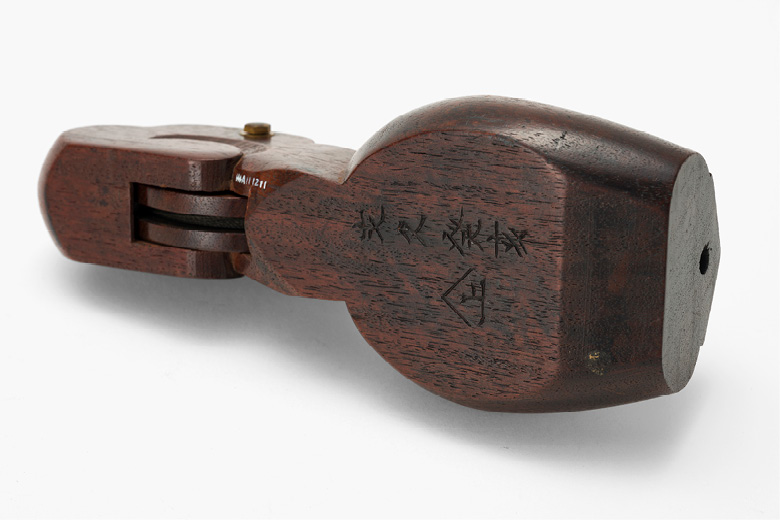
Many sumitsubo from the Edo period survive today, but only a small number can be dated with certainty. Here, we take as a point of reference a sumitsubo bearing a Bunkyu inscription from 1863 (Fig.5).
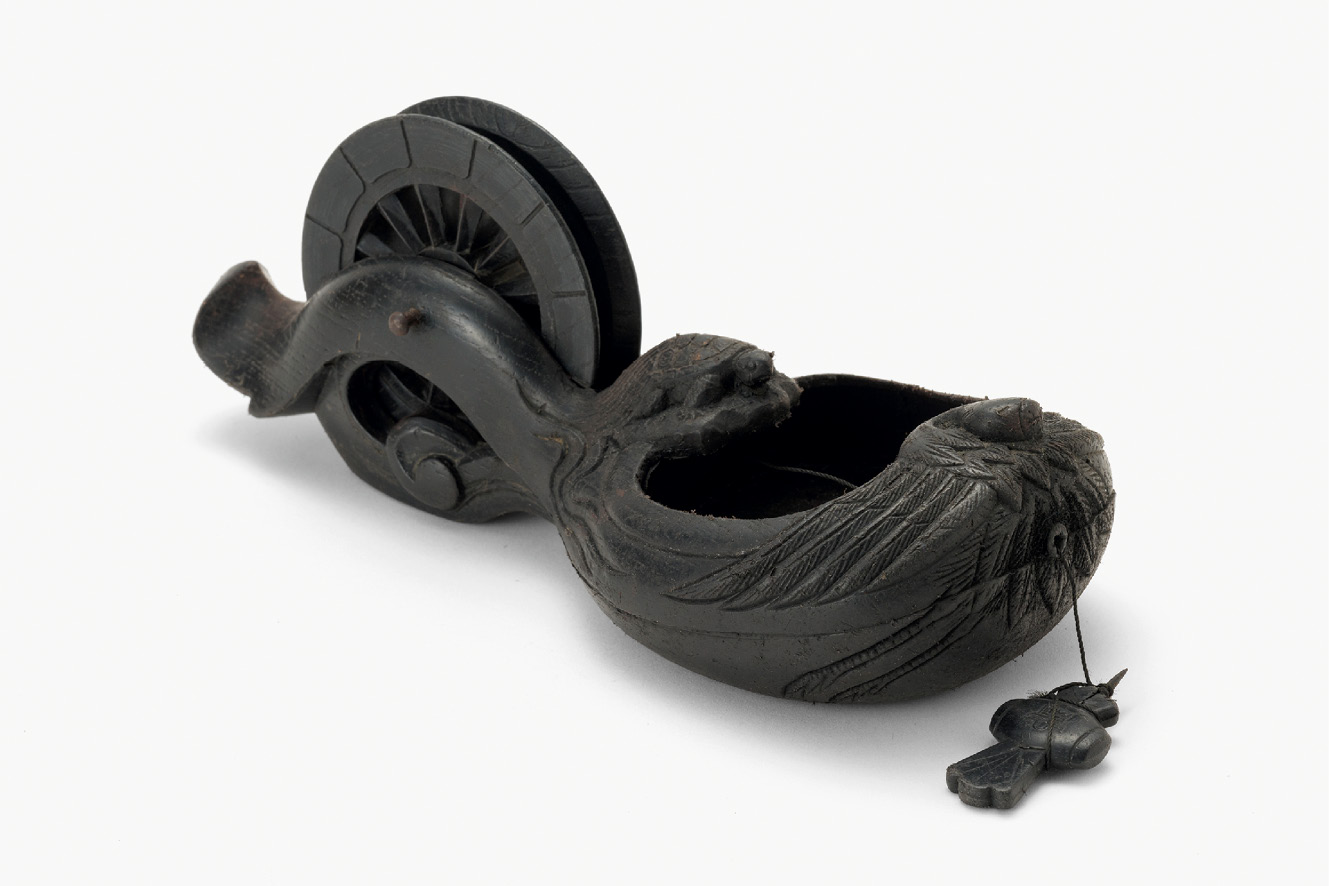
By this time, the earlier concave form had largely been replaced by a closed-ended type, designed to be more durable. The side plates became integrated with the body, and the fern-like forms evolved into cloud-shaped outlines. As dedicated plumb bobs came into use, hanging fittings were no longer needed.
As the ink line itself became finer, the reel grew thinner, allowing its diameter to increase. The ink reservoir was also enlarged so that the ink would dry less easily during outdoor work. Seen from above, the overall shape resembles a wooden rice paddle. This form has been carried forward into sumitsubo made today, indicating that wooden sumitsubo reached a mature and complete form by the late Edo period.
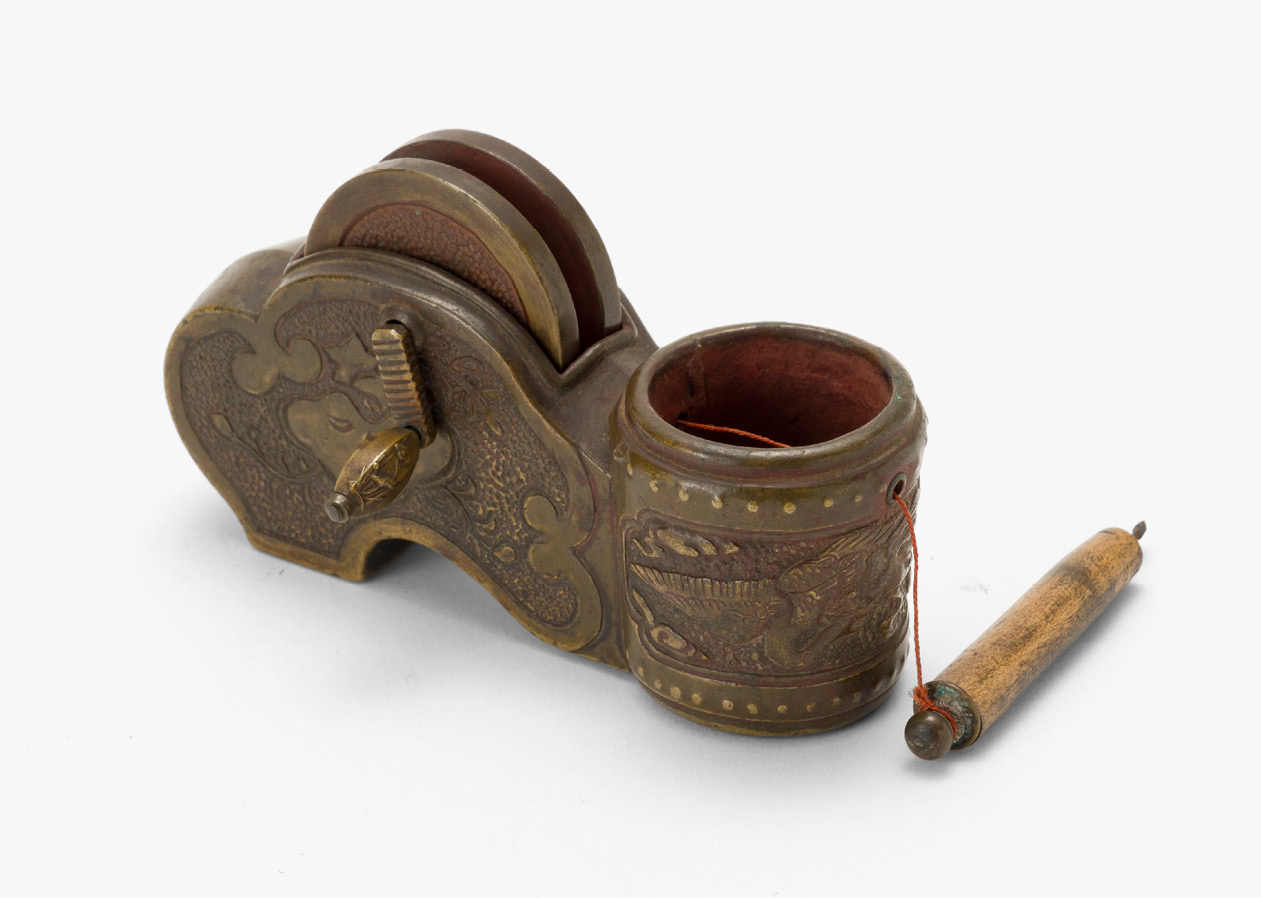
Fig.5Sumitsubo with Bunkyu inscription1863, wood, inv. A111211, 8.5 x 8.8 x 21.5 cmAn inscription reading 'Bunkyu mizunotoi (1863)' appears on the underside of the ink reservoir. The reel is a plain solid type without decorative treatment, yet the overall proportions are carefully considered. The head is formed by truncating the tip of a boat-shaped profile, while the tail curls into a spiral, a design that anticipates the later Genji type. The ceramic mouthpiece has not yet been fitted, and traces of wear from the line remain visible.Fig.6Bottom view of Fig.5 Fig.7Brass shutsubo with Tenpo 9 inscriptionChohichi, 1838, brass, Yasui Collection, inv. A111211, 6.2 x 5.7 x 12.0 cmAn inscription on the underside of the reservoir identifies the maker as Chohichi, a coppersmith. Made entirely of brass, it is adorned with finely executed metalwork and bears traces of use as a shutsubo for vermilion ink. The cylindrical reservoir is decorated with a phoenix, while the reel section curves in the form of a shrimp. Paulownia and bellflower motifs appear on the sides, lotus and tachibana on the handle, and the ground is finished with a nanako pattern. Fig.8Illustration from Saiga Shokunin Burui1784, inv. C140003Compared with medieval examples, the reel is noticeably thinner. Fig.9Illustration from Wakan Sansai Zue1712, inv. C190003The split-ended form remains, but the tail is closed. The text states that mulberry is the finest material, followed by zelkova.
4. The Age of Production: From Tokyo to Sanjo
Sumitsubo were traditionally made by the carpenters themselves, but not all were skilled at fine carving.
Some would have asked more accomplished colleagues to make one for them. In the mid-Meiji period, industrial development led to a rise in construction demand, and the number of carpenters increased accordingly. In Tokyo, one man began producing sumitsubo on commission and earned a strong reputation. Trading under the name Tsubokin, he expanded his business and eventually took on apprentices. As these apprentices went on to establish their own workshops, sumitsubo making developed into an industry.
Later, one of these craftsmen left Tokyo following an incident and relocated to Sanjo, Niigata, where he passed on his skills. In a region where heavy snowfall made indoor work essential during winter, sumitsubo production spread steadily. Sanjo eventually grew into a center of local sumitsubo manufacture. Meanwhile, increasing urbanization made production in Tokyo more difficult, and the craft gradually declined there. In the late 1960s, with the final works of Tsubotoyo, the once-flourishing tradition of Tokyo sumitsubo quietly came to an end.
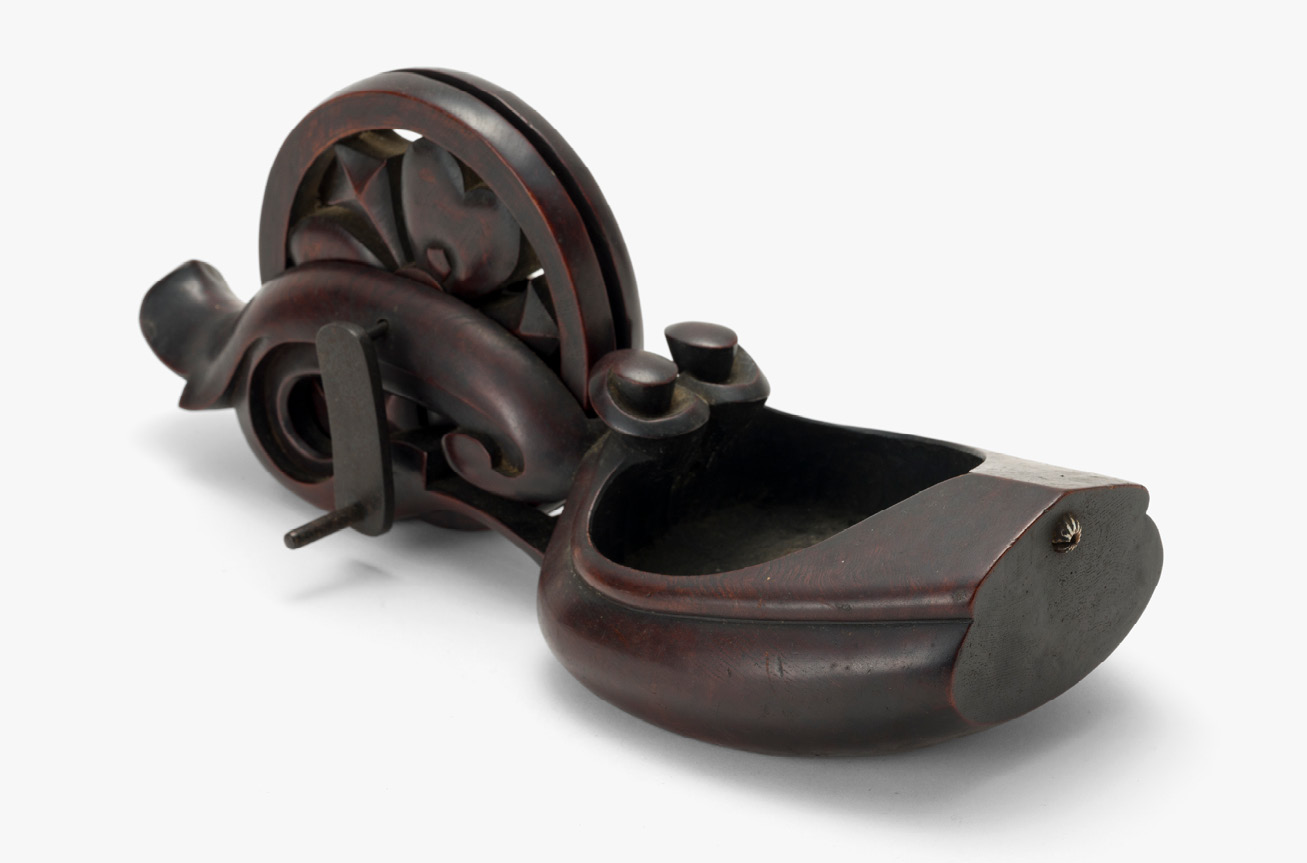
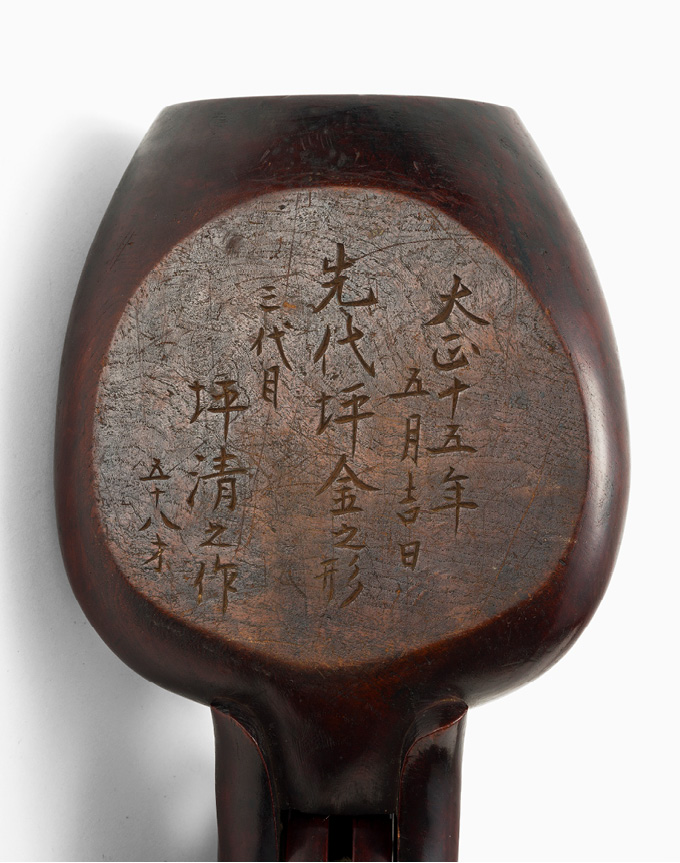
Fig.10Giant sumitsubo 'In the Style of the Former Master Tsubokin'Third-generation Tsubokiyo, 1926, keyaki, private collection, 16.0 x 41.0 x 16.5 cmThis is among the earliest known examples of a giant sumitsubo. An inscription on the underside of the reservoir reads: 'An auspicious day in May, Taisho 15. In the style of the former master Tsubokin. Made by the third-generation Tsubokiyo, aged fifty-eight.' Tsubokin is known as the craftsman who established the production of sumitsubo in Tokyo in the early Meiji period, and one of his disciples is said to have been Tsubokiyo. Since this piece is signed by the third-generation Tsubokiyo, it was likely produced by a craftsman in the Tsubokin lineage. While the truncated boat-shaped head reflects an older stylistic convention, the reel features an elegant openwork design combining inome-like shapes with lozenges. At the base of the reservoir, a boldly raised spiral motif is placed, and the reel stand is also deeply pierced. The tail curves upward like a young leaf, creating a strong sense of movement. Overall, the piece displays a level of sculptural refinement that goes beyond mere utility, revealing the distinctive artistry of a professional sumitsubo maker.Fig.11Bottom view of Fig.10 (inscription)
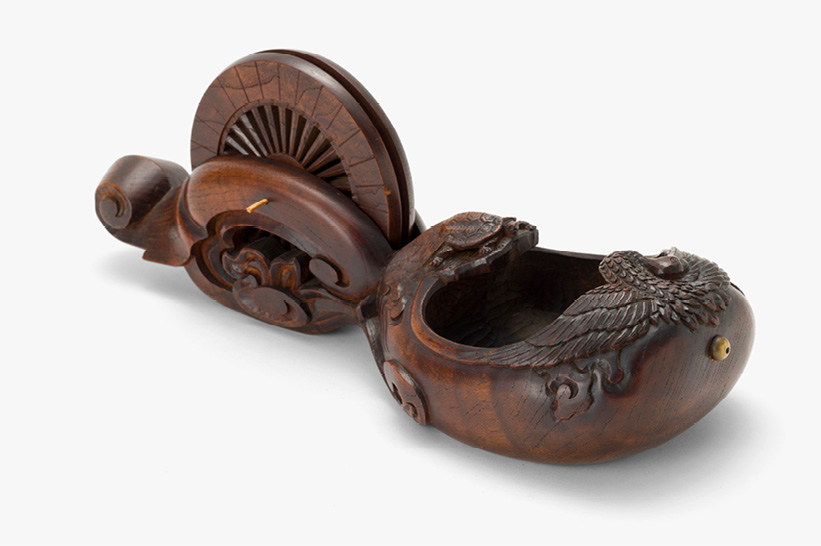
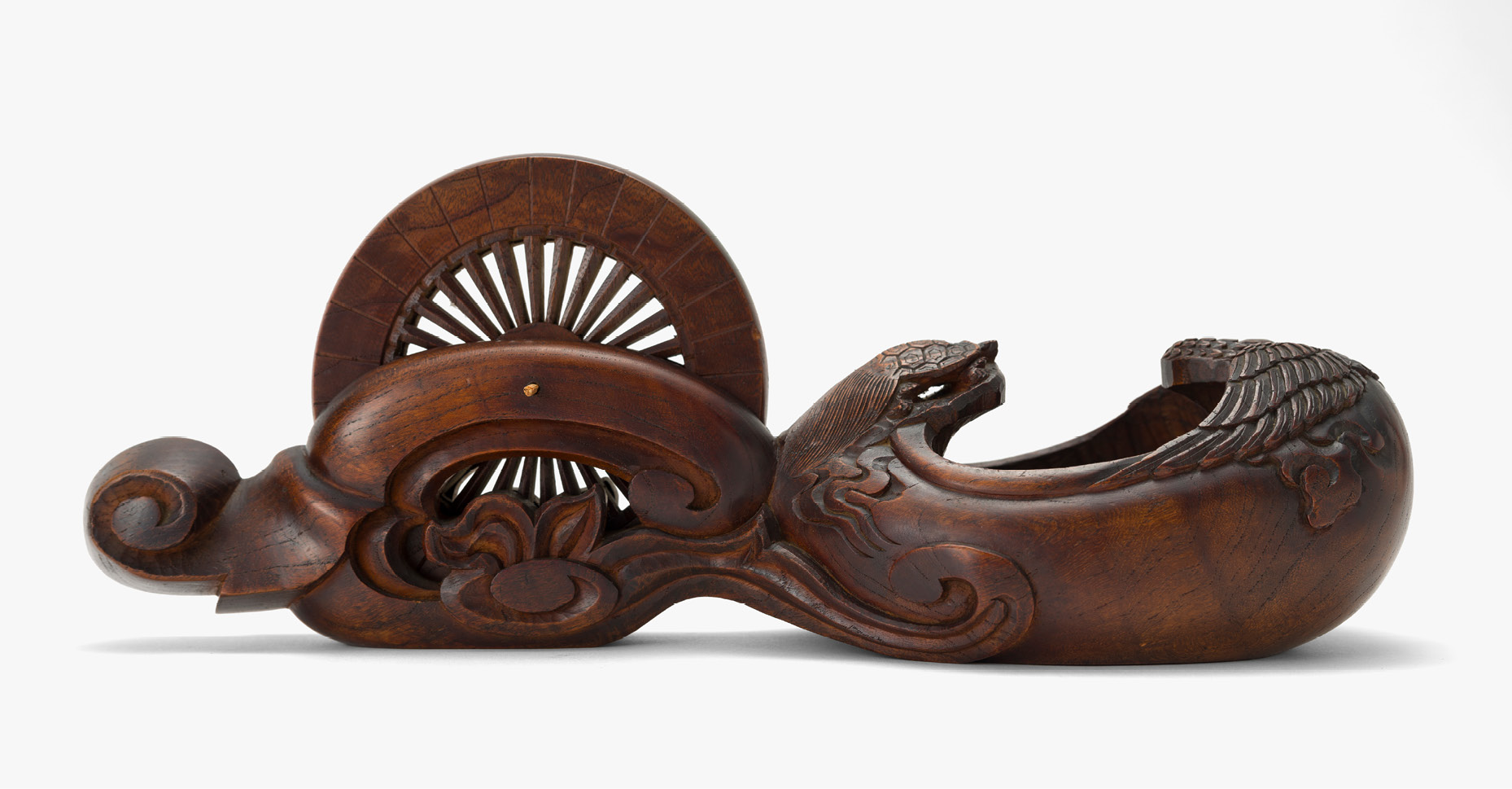
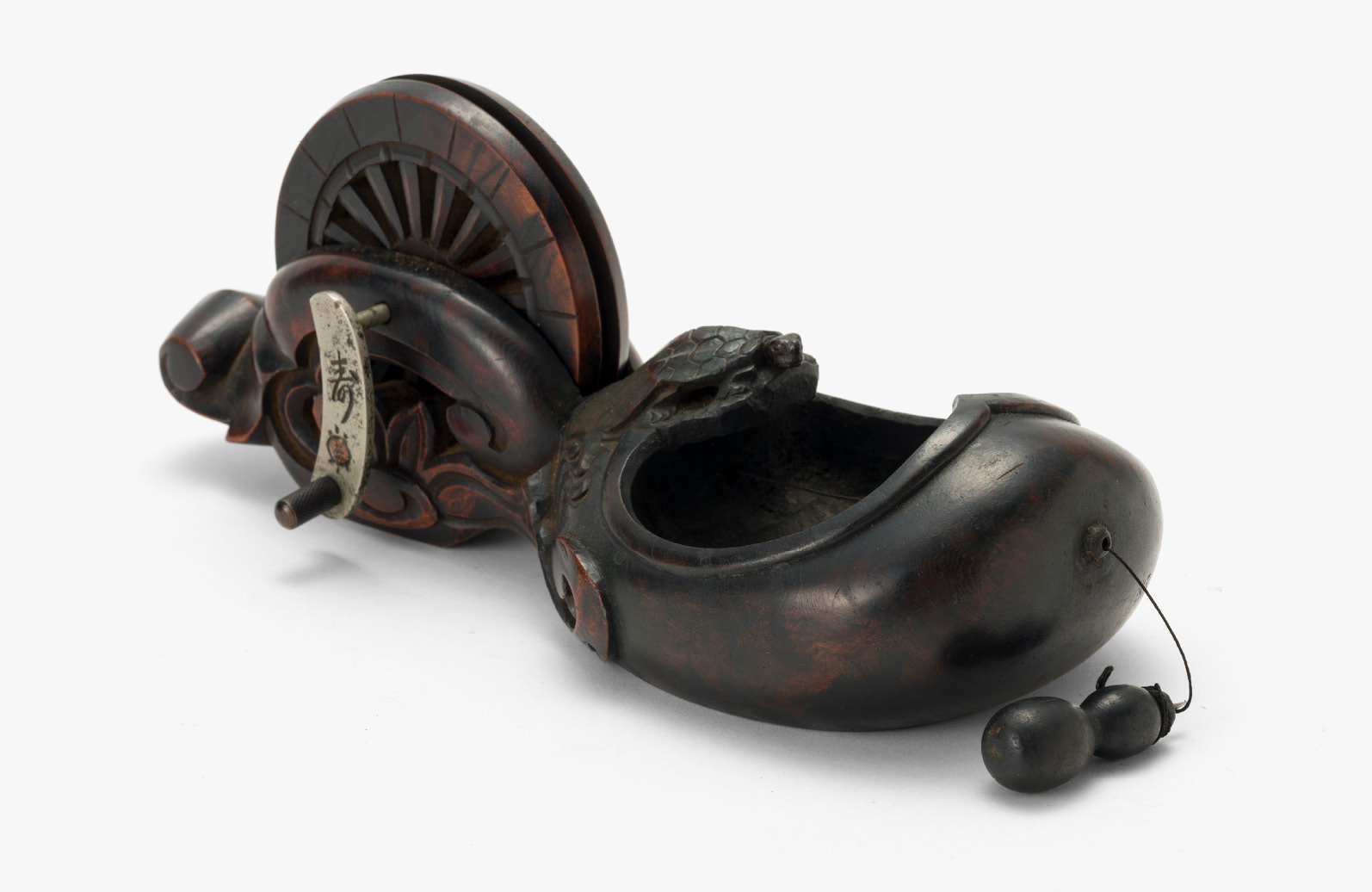
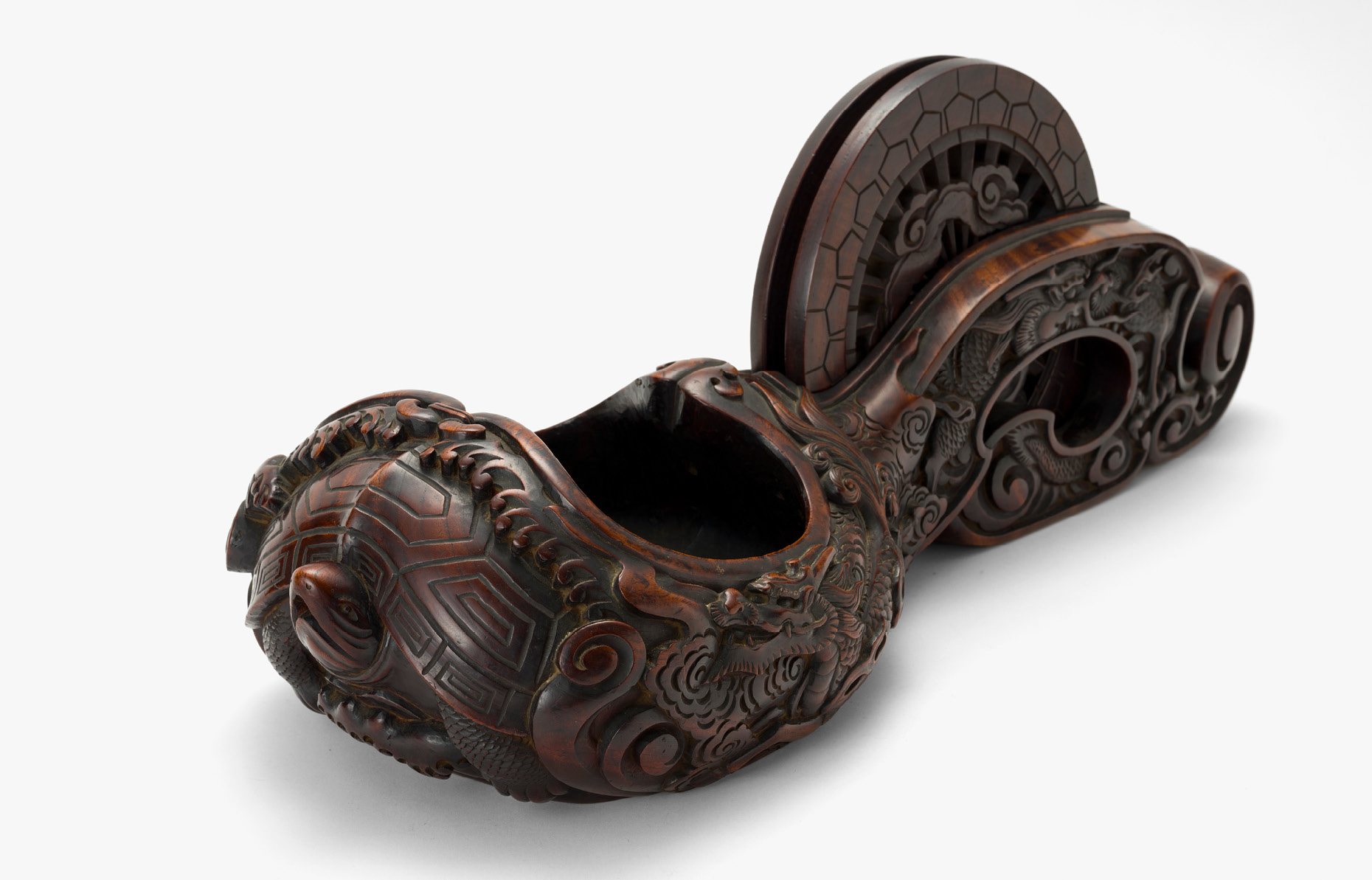
Fig.12Giant sumitsubo 'Crane and Tortoise'Second-generation Tsubotoyo, mid-20th century, Tokyo, keyaki, 16.0 x 16.5 x 41.0 cmMade by the second-generation Tsubotoyo (Omi Shokichi, born 1904). The first-generation Tsubotoyo (Omi Toyokichi, born 1875) entered the workshop of Tsubosen, a disciple of Tsubokin, in 1891. The second generation was his son and became known as a master of Tokyo-style sumitsubo, noted for refined and balanced forms. Around 1963, he fell ill and retired.Fig.13Side view of Fig.12
Fig.14Sumitsubo 'Tortoise'Tsubotoyo, mid-20th century, Tokyo, keyaki, inv. A112496, 10.2 x 24.6 x 10.5 cmThe name 'Tsubotoyo' is stamped on the reverse. This piece is thought to be the work of either the second or third generation. The third generation moved from Tokyo to Ibaraki and continued production there, but the workshop closed in the late 1960s.
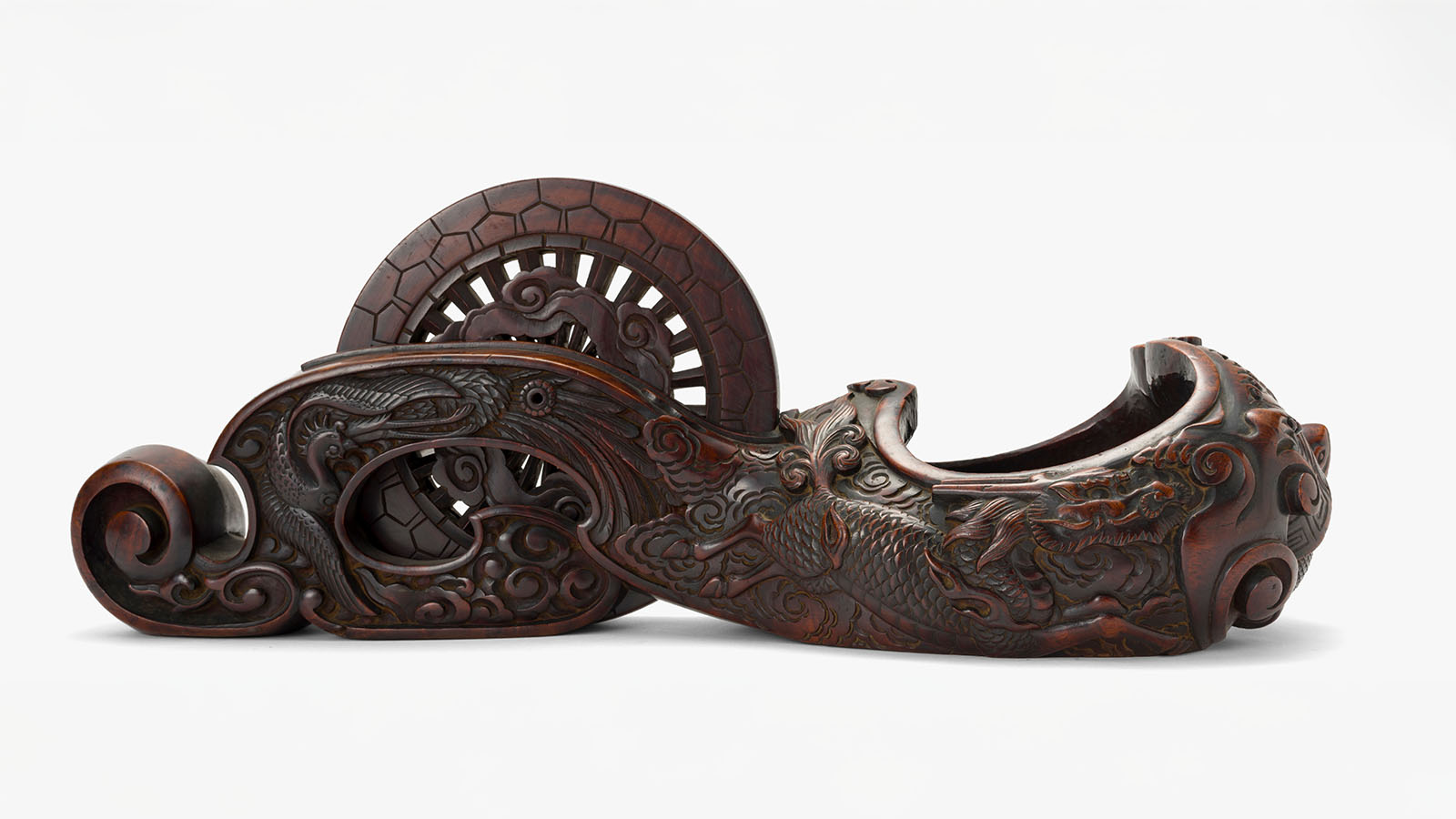
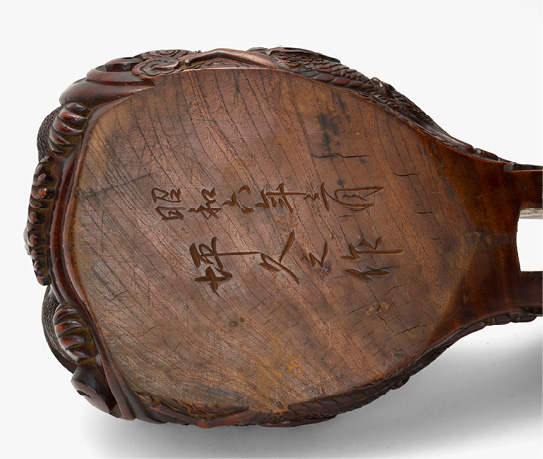
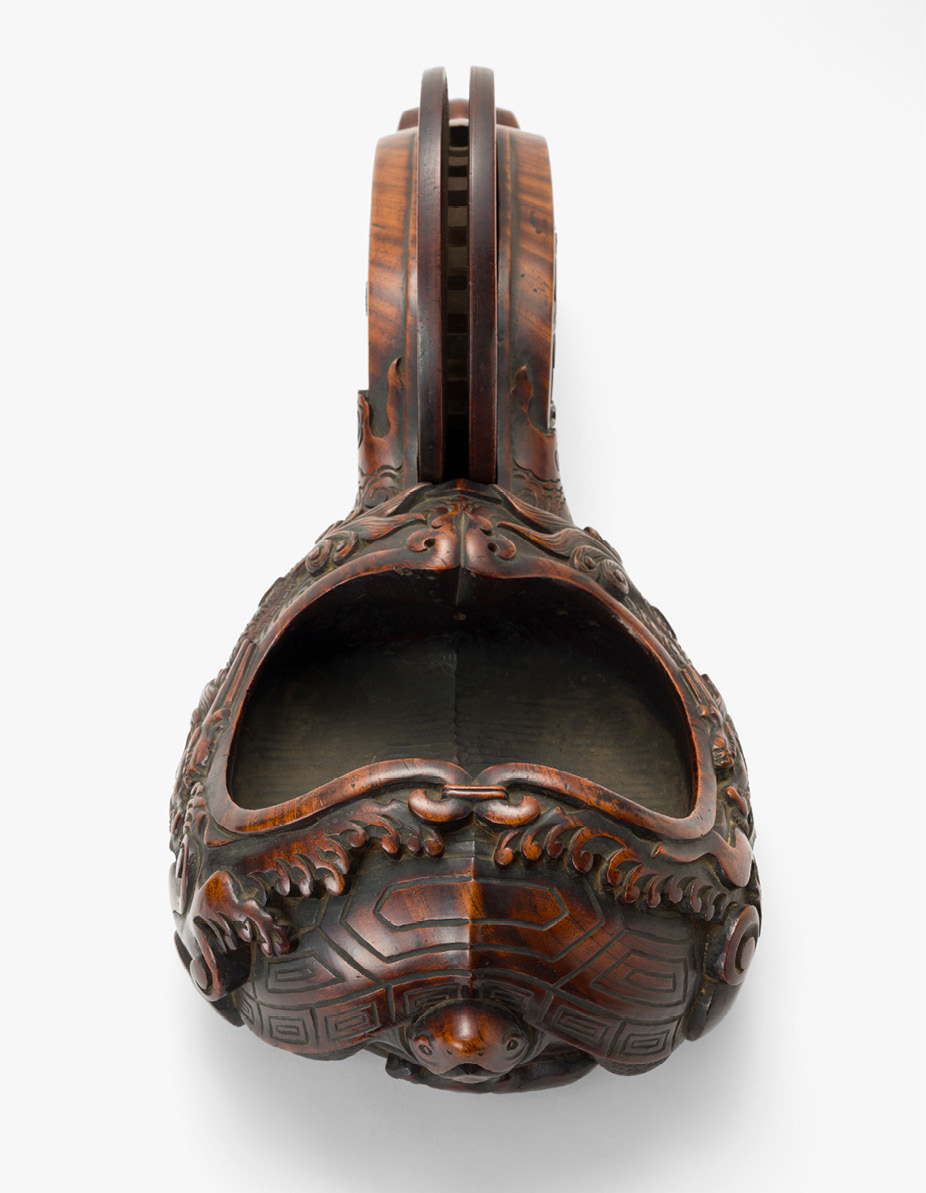
Fig.15Giant sumitsubo 'Four Auspicious Beasts'Tsubohisa, 1931, Tokyo, keyaki, inv. A111017, 25.0 x 67.0 x 25.0 cmThe head is carved with a tortoise, the sides with a qilin, and the tail with a phoenix and a dragon, together representing the Four Auspicious Beasts of the Chinese cultural sphere. Carving four separate motifs into a single work often risks upsetting the balance, but here the composition is skillfully unified, suggesting a maker of considerable ability. An inscription on the underside reads, 'Showa 6, third month, made by Tsubohisa,' identifying both the date and the maker. Little is known, however, about Tsubohisa himself, who appears to have been a sumitsubo craftsman active in Tokyo.Fig.16Side view of Fig.15Fig.17Bottom view of Fig.15 (inscription)Fig.18Front view of Fig.15
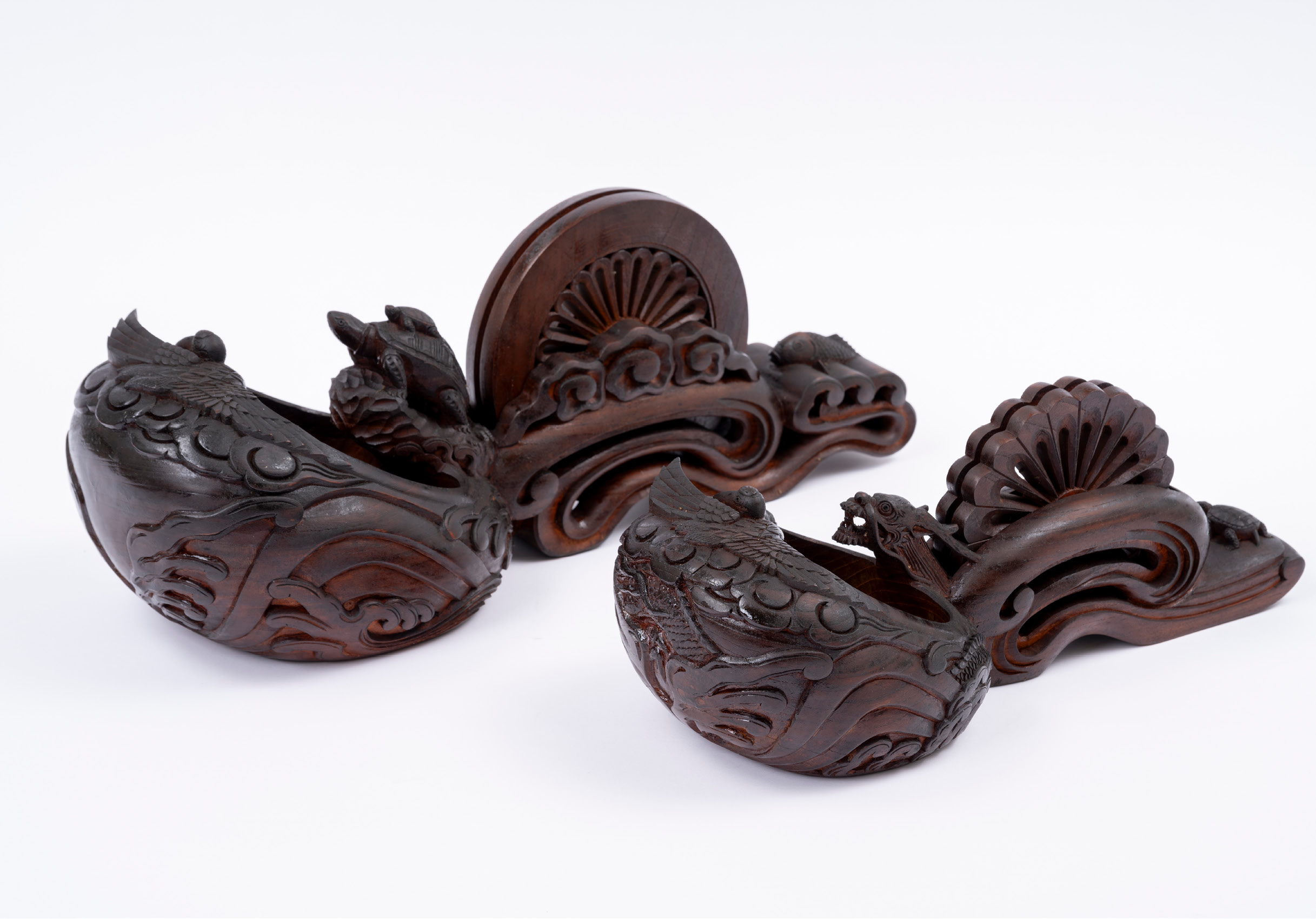
5. Giant Sumitsubo: The Rise and Fall of Sanjo Sumitsubo
From the postwar reconstruction period through the years of rapid economic growth, construction demand expanded explosively. As a result, sumitsubo produced in Sanjo sold in extraordinary numbers. Even after the introduction of machinery and mass production, output could not keep pace with demand.
As the number of craftsmen increased, some distinguished themselves through exceptional carving skill, notably Ichimonji Masakane and Shigetaka. The sumitsubo they produced came to be valued increasingly for their decorative qualities rather than for practical use, with an ever greater emphasis on opulence. Consequently, the sumitsubo themselves grew in scale, giving rise to oversized examples exceeding one shaku, over 30 cm in length, known as giant sumitsubo. These were used primarily as eye-catching display pieces in tool shops.
At the same time, rising demand also encouraged the emergence of plastic sumitsubo. Durable and well suited to mass production, they quickly displaced wooden sumitsubo from the market. Orders for giant sumitsubo continued until the years of the economic bubble, but with its collapse, demand disappeared. In the Reiwa era, this distinctive craft of wooden sumitsubo production, rare even by global standards, is quietly drawing to a close.
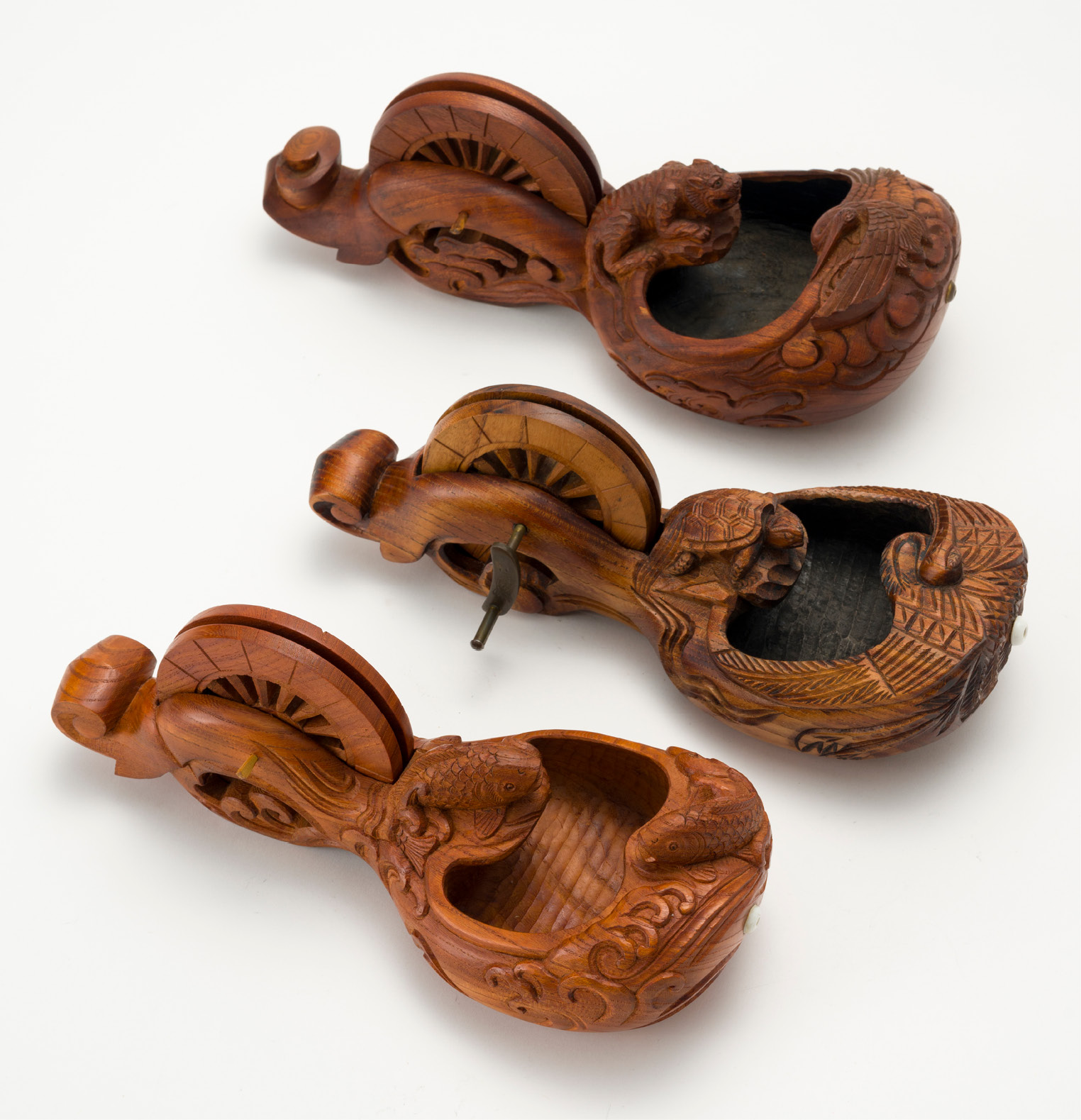
Fig.19Sanjo sumitsuboa. 'Crane and Tortoise,' Ichimonji Masakane, 1984, keyaki, inv. A110668, 10.0 x 28.0 x 11.5 cm b. 'Crane and Tortoise,' Tsuboyoshi, late 20th century, keyaki, inv. A112692, 9.6 x 27.0 x 11.2 cm c. 'Carp,' Tsubotatsu, 1985, keyaki, inv. A110668, 10.0 x 28.0 x 11.5 cmInheriting the Tokyo sumitsubo lineage, many Sanjo examples are based on the wakaba form, with auspicious motifs and mythical creatures carved around the reservoir.
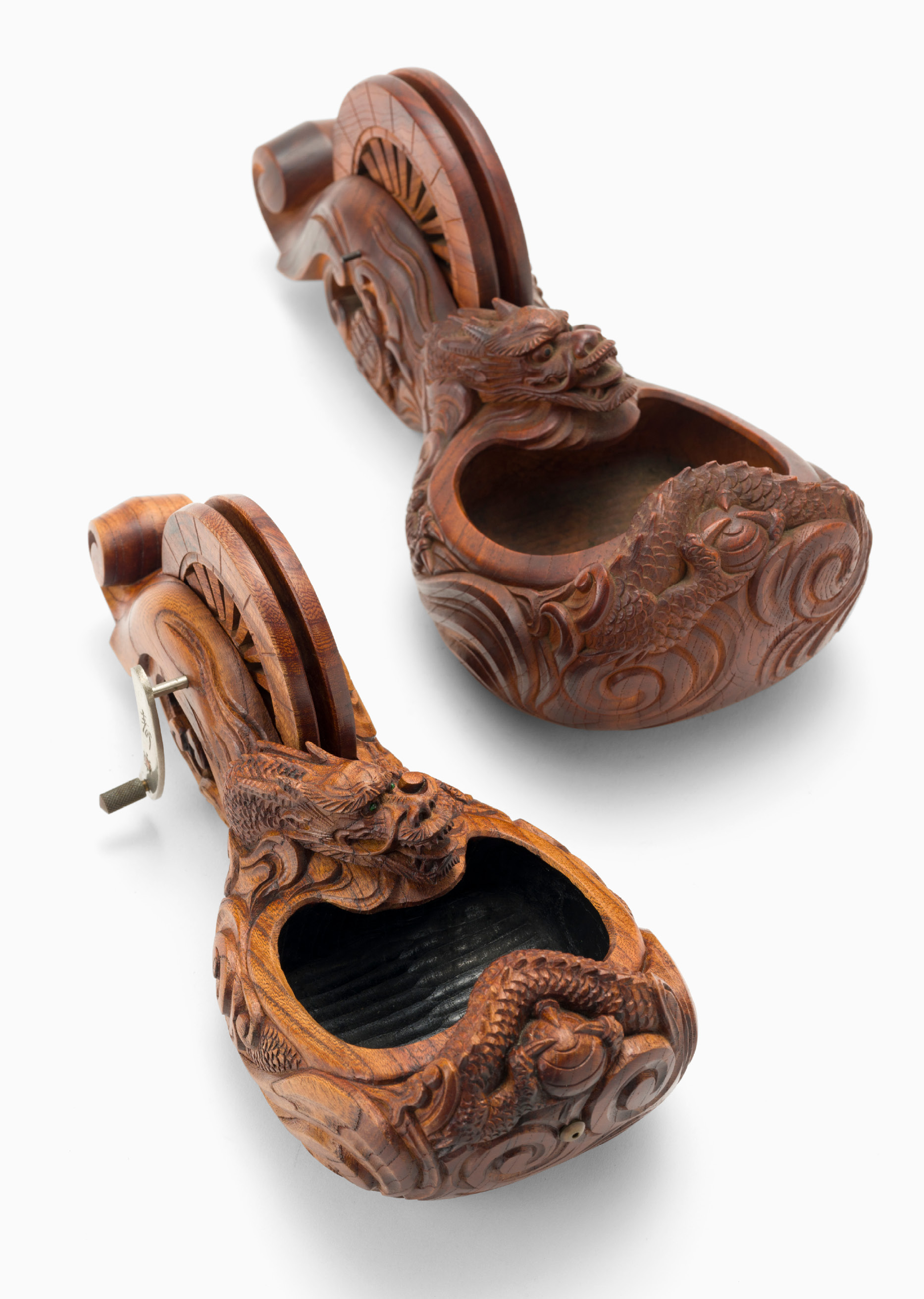
Fig.20Giant sumitsubo 'Water Dragon'a. Juo, late 20th century, keyaki, inv. A112652, 12.8 x 34.5 x 14.5 cm b. Shigetaka (Shinbo Koichi), late 20th century, keyaki, inv. A112691, 11.5 x 30.5 x 12.3 cmThe water dragon, a sacred creature associated with water, clouds, and rain, is rendered in a fluid, dynamic form. As a symbol of flood control, fire prevention, and safety in construction, it was a favored subject for carving. The body coils around the reservoir, the face appears at the center, and the tip is shown grasping a sacred jewel.
*Shinbo Koichi (born 1927), a sumitsubo craftsman, began carving sumitsubo in Sanjo after the war and produced works under the signature 'Shigetaka.' He was especially known for delicate carving and for making many giant sumitsubo.
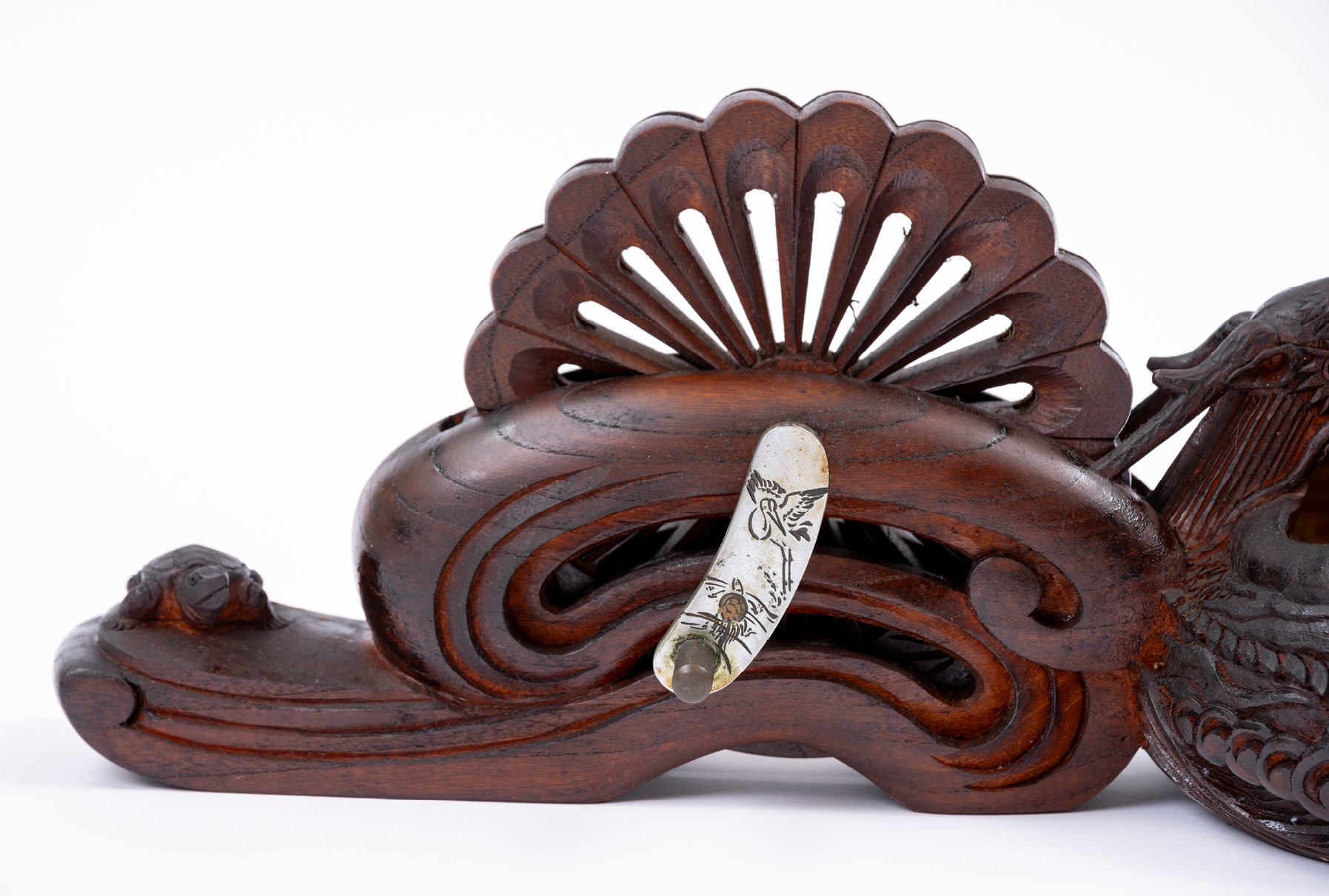
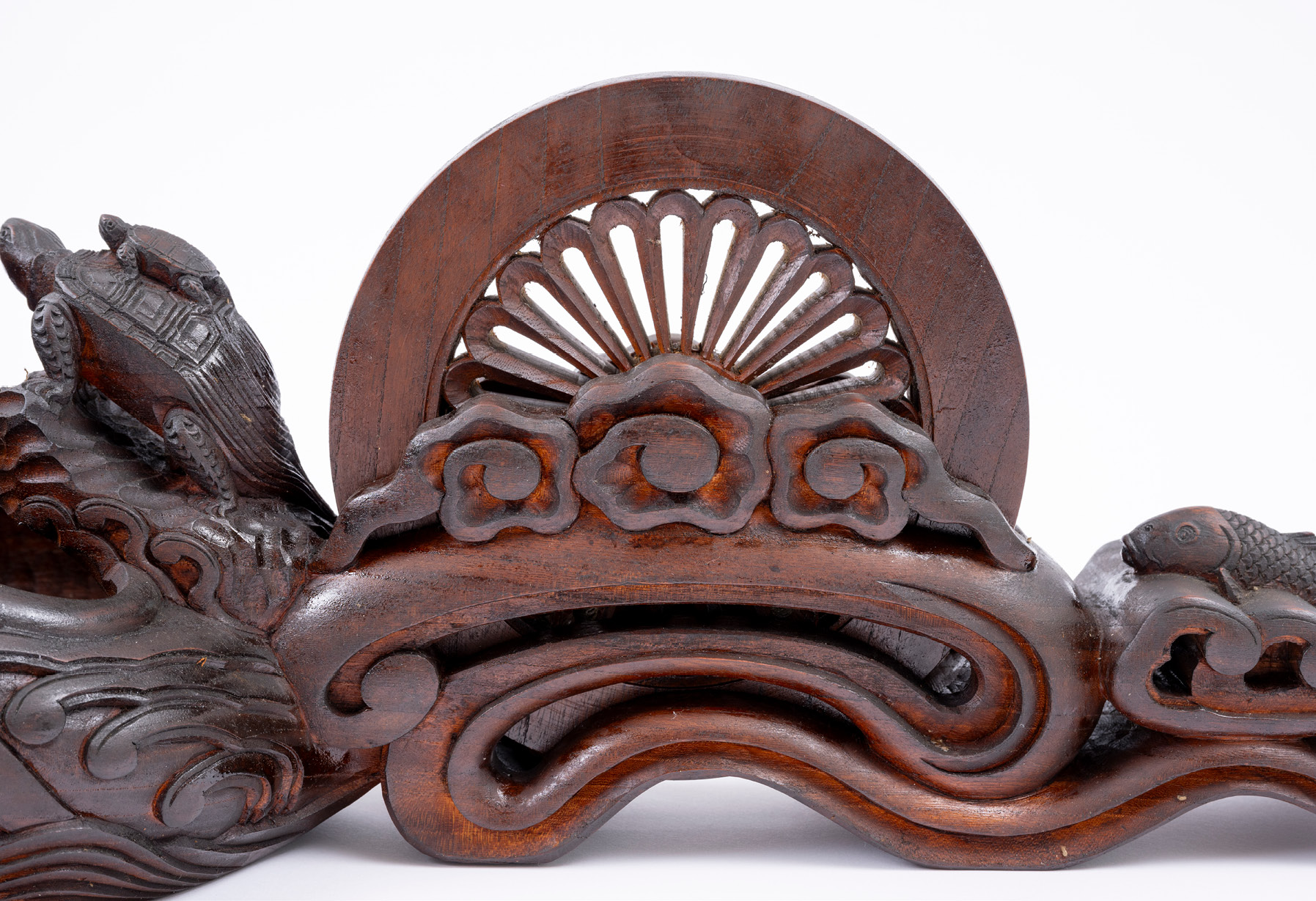
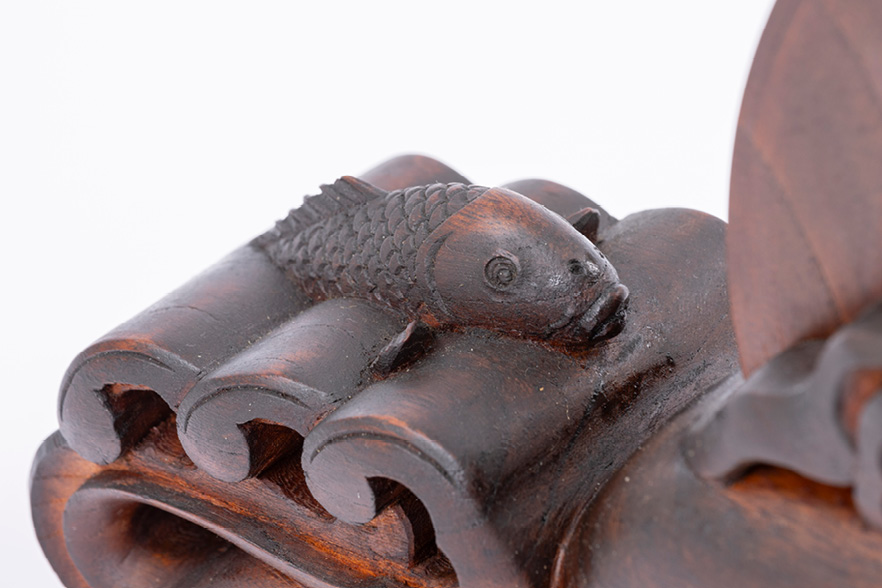
Fig.21Giant sumitsubo 'Crane and Tortoise' and 'Dragon and Crane'a. Ichimonji Masakane, 1980s, Sanjo, keyaki, inv. A112695, 19.5 x 52.0 x 20.5 cm b. Ichimonji Masakane, 1980s, Sanjo, keyaki, inv. A112696, 15.0 x 42.5 x 16.5 cmThese giant sumitsubo once adorned the storefront of a tool shop in Tokyo. While based on the standard arrangement of crane and tortoise motifs, they heighten three-dimensionality by including details such as a parent-and-child tortoise and a dragon emerging from the water. The reel is decorated with openwork carving of the kikusui motif, further enhancing the sense of depth. A carp leaping up a waterfall is charmingly carved on the tail. In both examples, the head is cut high at an angle to accentuate the image of a crane spreading its wings wide. Though somewhat exaggerated in impression, the overall form conveys a strong sense of dynamism.Fig.22Side view of 'Dragon and Crane'Fig.23Side view of 'Crane and Tortoise'Fig.24Tail detail of 'Dragon and Crane': leaping carpFig.25Tail detail of 'Dragon and Crane': small tortoise
Obara Kanekichi, a sumitsubo craftsman, was born in Sanjo in 1924. After graduating from elementary school, he entered an apprenticeship, later returned from military service after World War II, and established himself independently. Renowned for his speed, he was said to complete twice the amount of work of others. He went on to produce many crane-and-tortoise motifs and is also remembered as the figure who transformed the crane's wings, previously shown in a flatter manner, into rounded, more sculptural forms. Later adopting the name 'Ichimonji Masakane,' he devoted himself to the production of giant sumitsubo. In his later years, he worked exclusively on commissioned giant sumitsubo. Stories of his bold personality also survive: his passion for sports cars and koi keeping, and his willingness to spend freely the money he earned from his work.
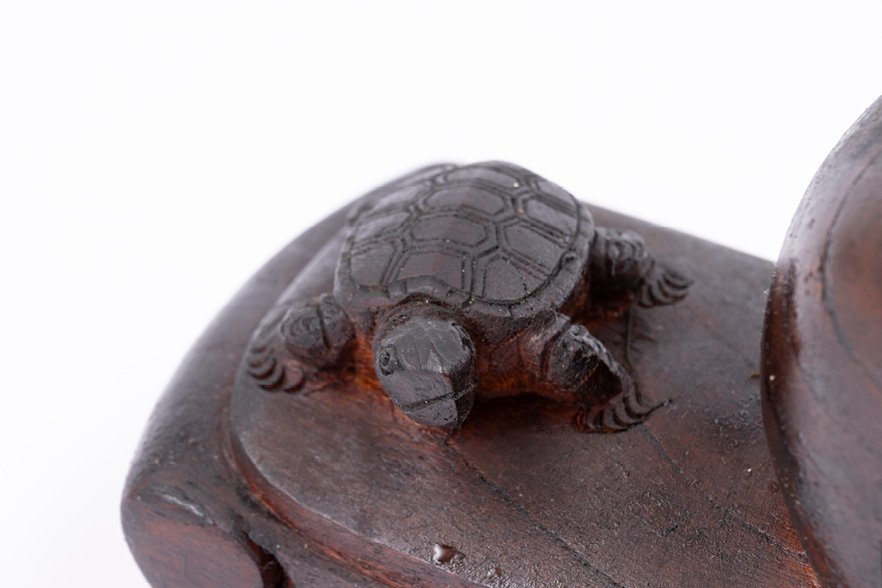
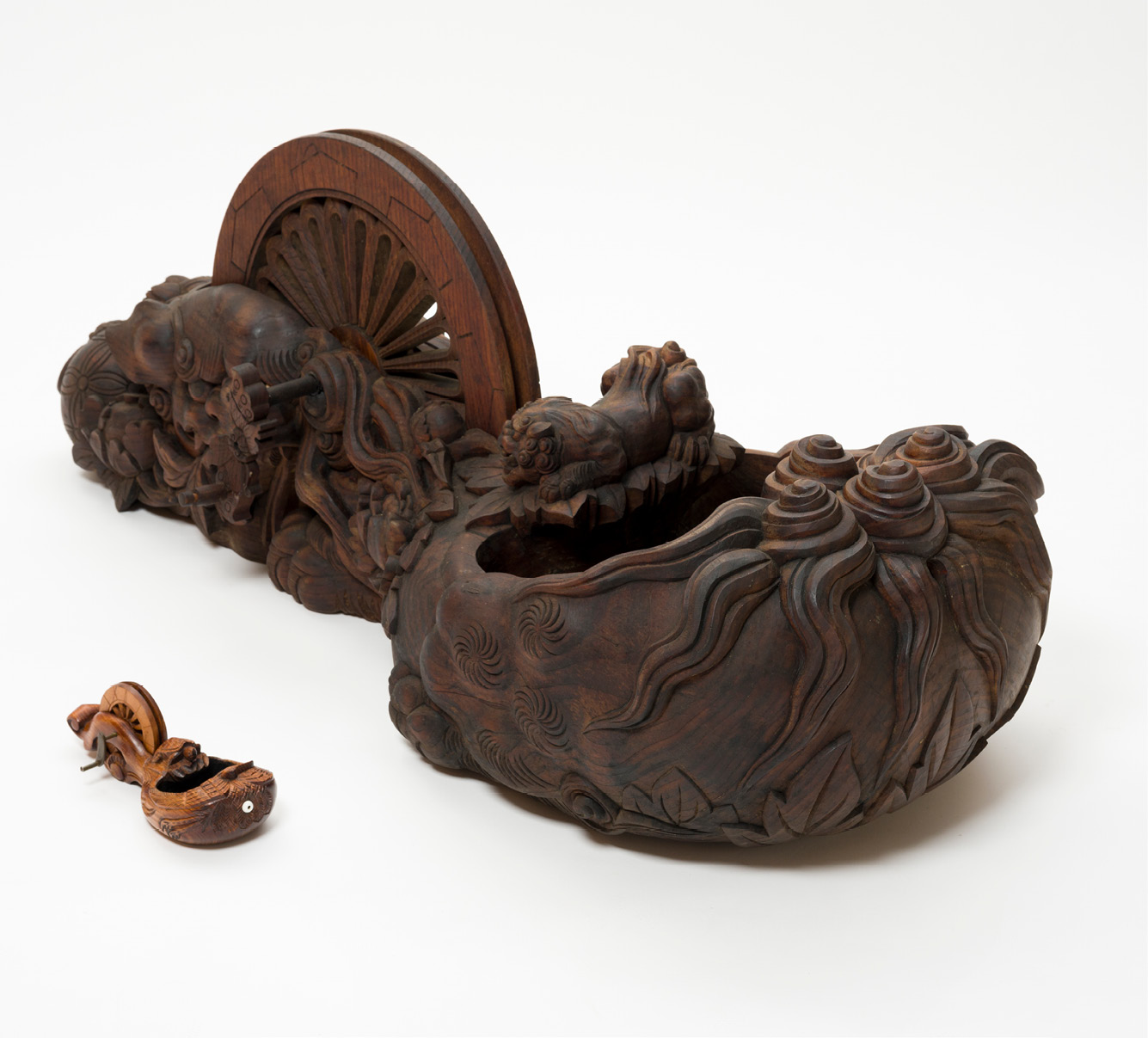
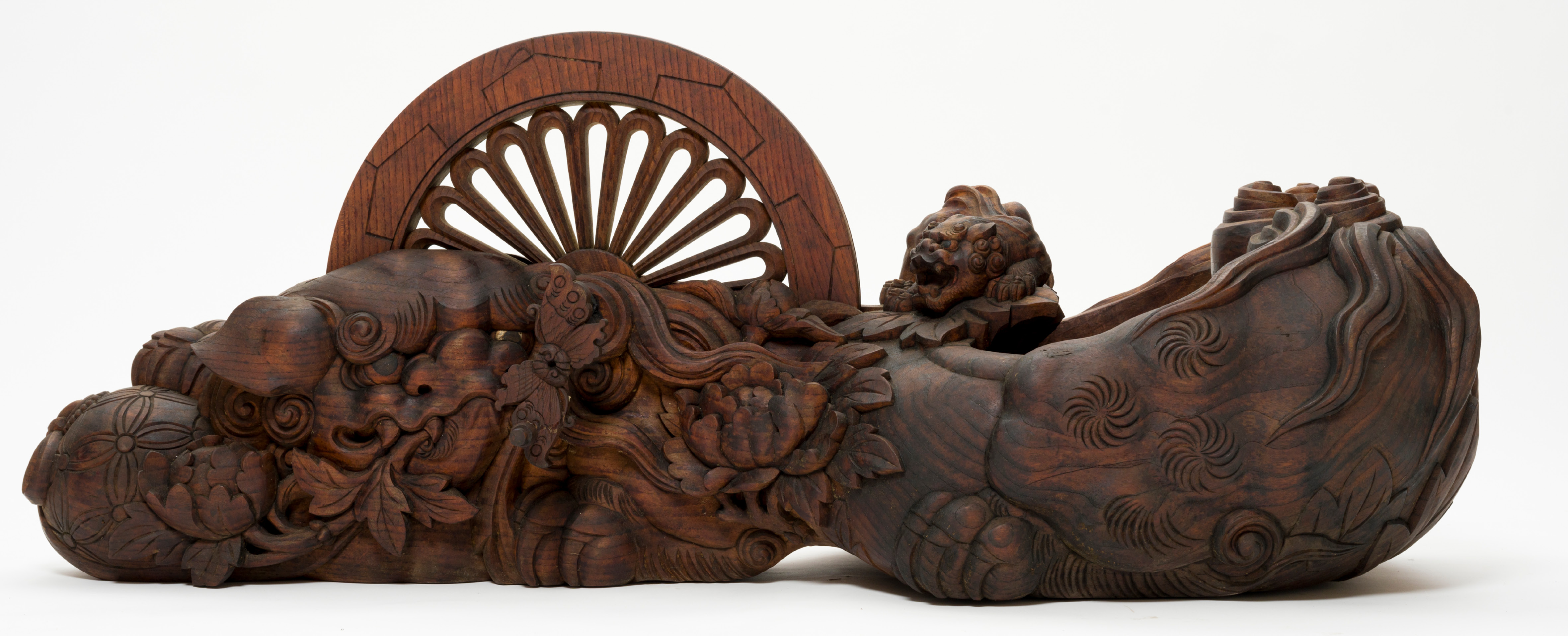
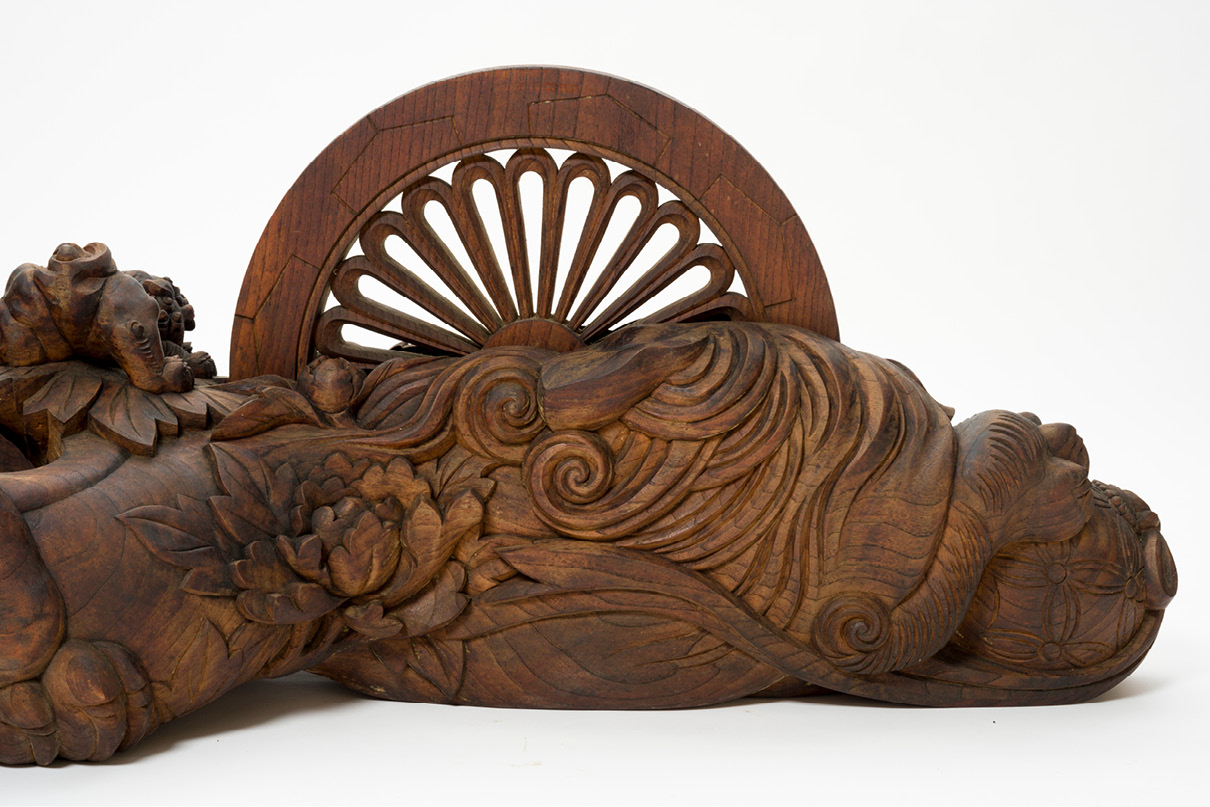
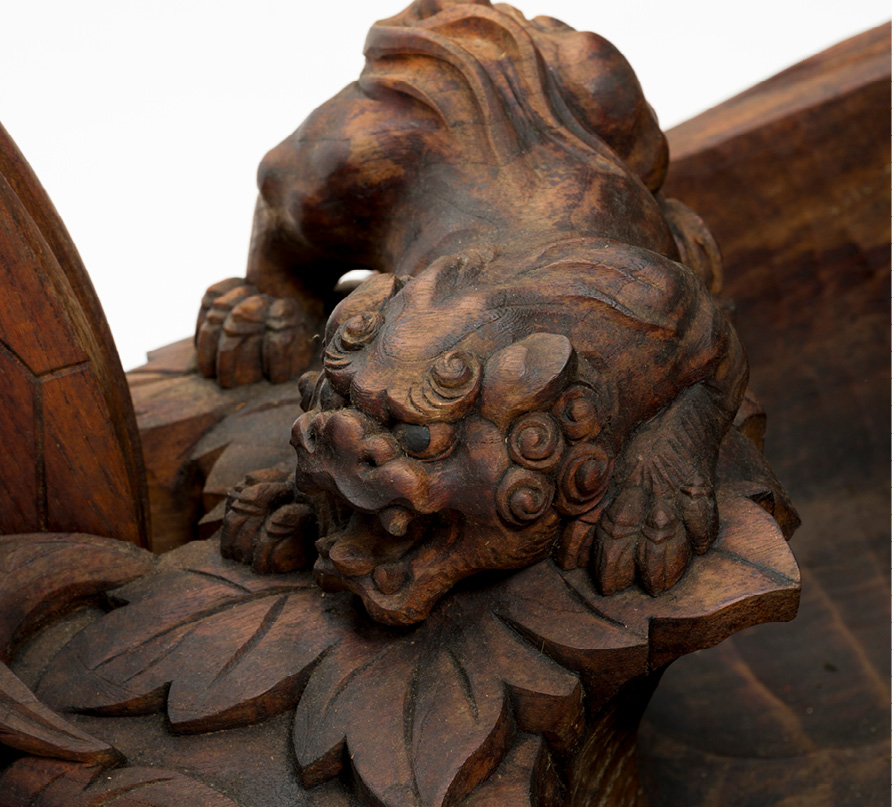
Fig.26Giant sumitsubo 'Lion and Cub at Play'Tanaka Saburo, 1975, Nagaoka, keyaki, inv. A112680, 52 x 130 x 55 cmThis giant four-shaku-long sumitsubo was commissioned by a Niigata tool wholesaler as a showpiece for events. The inscription on the storage box describes it as 'Japan's largest sumitsubo.' Because of its enormous size, the carving was executed not by a sumitsubo craftsman but by the sculptor Tanaka Saburo. The motif, lion and cub at play, is of Chinese origin and depicts an adult lion playing with its cub. The adult lion is carved across the body of the sumitsubo, with its face placed on the side plate of the reel. The small figure standing between the reel and the reservoir represents the cub. The sumitsubo shown at left in the photo is a standard 8-sun example, about 24 cm long.Fig.27Side view of Fig.26Fig.28Side view of Fig.26Fig.29Detail of Fig.26: lion cub
Fig.30Synthetic resin sumitsubo1970s, synthetic resin, inv. A110067, 9.2 x 23.5 x 10.0 cmThis type became widespread from around the 1970s. It was valued for being inexpensive and resistant to breakage even when dropped. It was sold under the name 'Cho-un.' The Japanese text records a correction stating that the original prototype was made not by Ichimonji Masakane, as previously stated, but by the sumitsubo craftsman Koyama Misao.
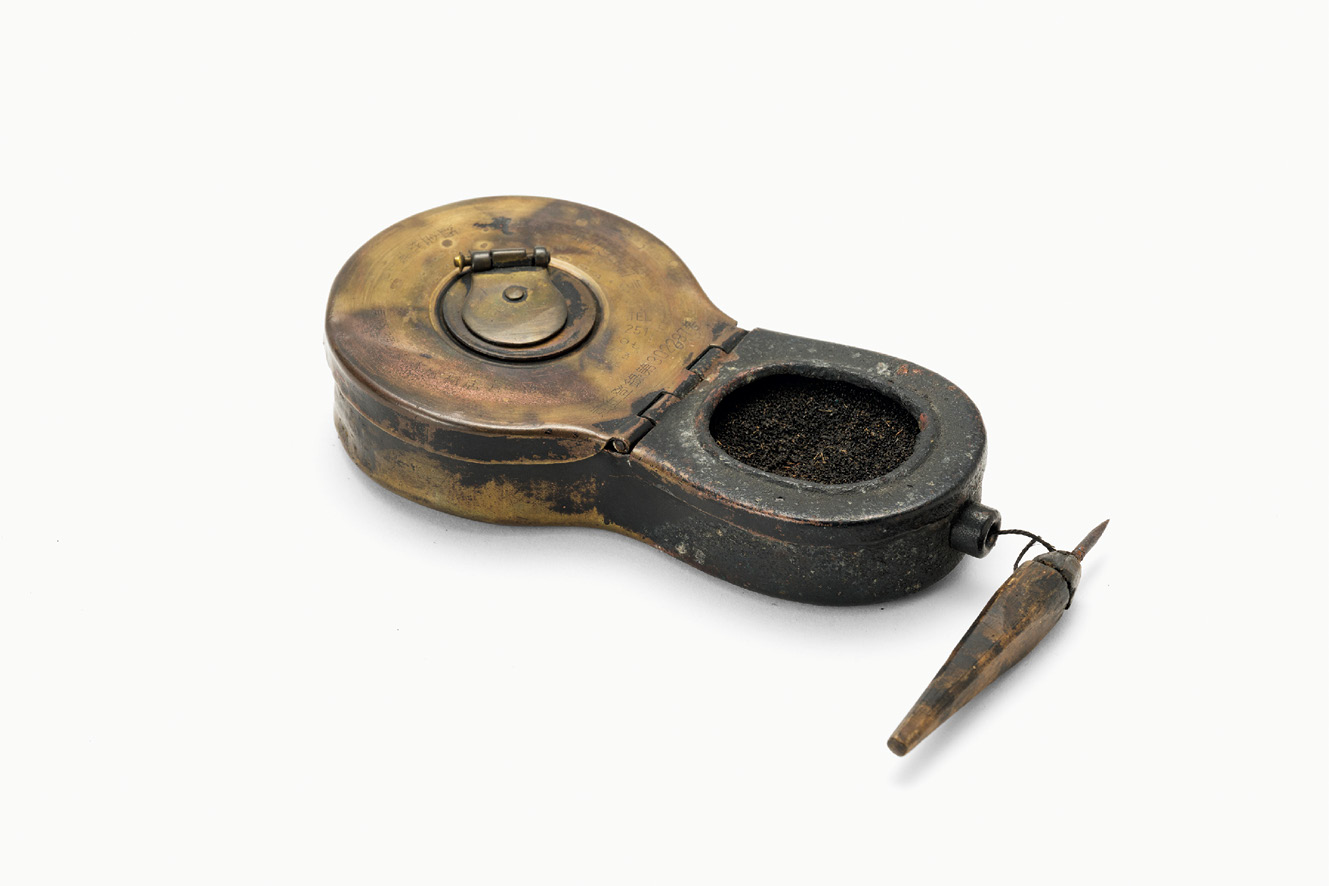
Fig.31Brass side-winding sumitsubo1970s, brass, inv. A112007, 7.0 x 8.0 x 16.8 cmBy using brass for the body, the tool was made thinner, and by adopting a side-winding design, surface irregularities were reduced, resulting in a more compact form. The design was registered in 1969.
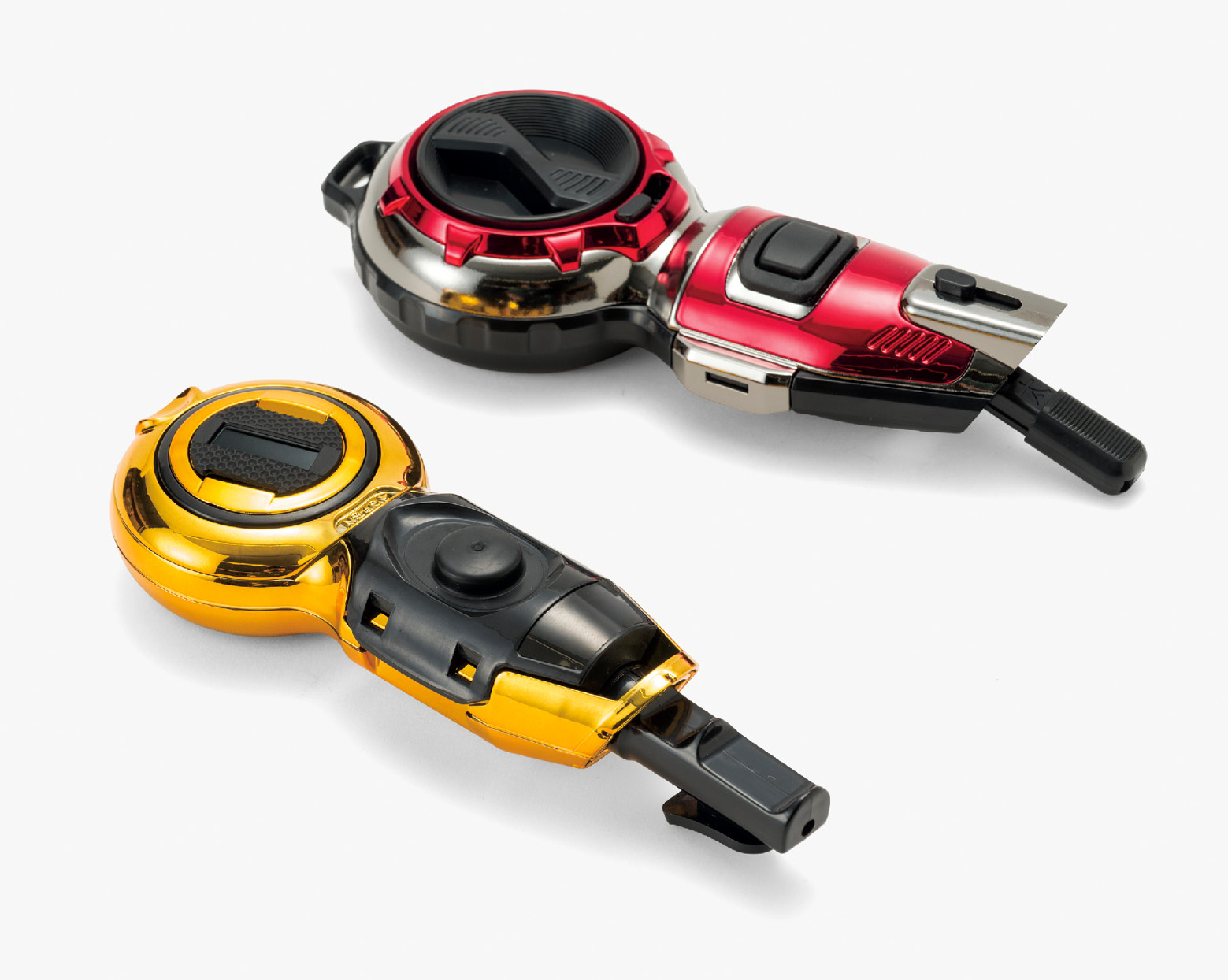
Fig.32Modern commercially available sumitsuboMade of durable plastic, modern sumitsubo offer a wide range of features far beyond those of traditional wooden versions. These include an automatic line-rewinding mechanism, a system that prevents ink leakage, an easy-to-grip resin neck, and even a holder for attaching the tool to a belt.
Legend
Captions for the exhibited objects and the catalogue are arranged in the following order: object name, maker, date of production, place of production, materials, owner / inventory number, and dimensions. When information is unknown, the relevant item is omitted.
Most of the exhibited objects are from the collection of the Takenaka Carpentry Tools Museum; therefore, ownership information is omitted for these items, and inventory numbers are given instead (six-digit numbers prefixed with "inv. + A," "C," or "E").
The museum's sumitsubo holdings comprise three collections. When applicable, these are indicated in the captions: (1) the Takeo Yasui Collection, (2) the Akiyoshi Suda Collection, and (3) the Hakuzan Shionoya Collection.
Each figure is assigned a consecutive number, which is placed before the title. When multiple objects appear within a single figure, they are distinguished by the letters a, b, c in order from top to bottom. Items presented for reference only and not exhibited are indicated as "Reference image."
Object dimensions are given in the order of height x length x width.